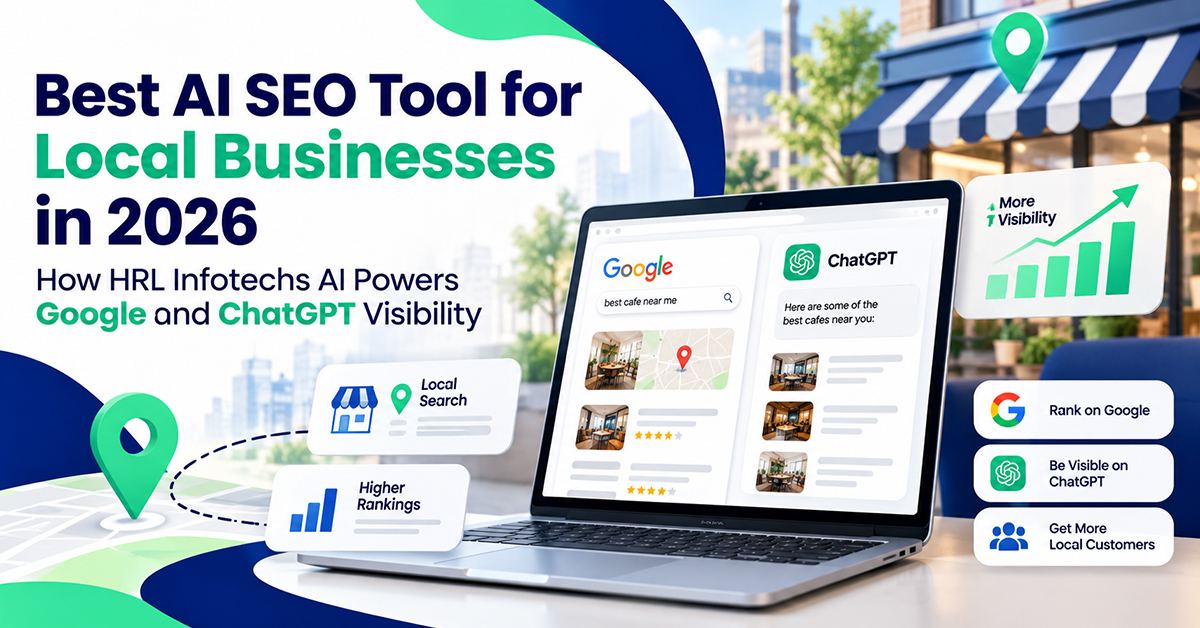
A hair salon owner in Pune messaged us last month with a specific complaint. Her Google ranking hadn't moved. Reviews were strong, the profile was complete, foot traffic was steady. But when she asked ChatGPT "best hair salon near Koregaon Park," her salon never came up. Three competitors did, including one with fewer reviews than her.
That gap between ranking on Google and existing on ChatGPT is the new problem local businesses are running into, and most owners don't know it's happening until a customer mentions it. Traditional SEO got your café, your clinic, or your repair shop into the map pack. It does almost nothing to get you mentioned when someone asks an AI assistant for a recommendation instead of typing a search query. Those are two different systems now, and they reward different things.
What Is AI SEO for Local Businesses?
AI SEO for local businesses means optimising your online presence so you show up in two places at once: the traditional Google local pack, and the answers ChatGPT, Gemini, and Perplexity give when someone asks for a recommendation. The first relies on Google's ranking signals. The second relies on a related but separate discipline called generative engine optimisation, or GEO, which is about structuring your information so an AI model can find it, trust it, and cite it.
The two overlap more than most owners realise. A clean Google Business Profile, consistent business details across the web, and a steady flow of reviews feed both systems. But GEO adds its own requirements on top: your website needs clear, factual, well-structured content that answers the exact questions customers ask, because AI models pull from text, not just listings. A gym with a beautifully designed homepage and zero blog content answering "how much does a personal trainer cost in Jaipur" is handing that query to whichever competitor actually answered it.
Why Isn't Your Local Business Showing Up on ChatGPT or Google AI Overviews?
Most local businesses are invisible in AI search for one of three reasons: inconsistent business information across the web, a Google Business Profile that's complete but inactive, or a website with no content written to directly answer customer questions. Any one of these is enough to keep you out.
Take a dental clinic as an example. If the clinic's name, hours, or address differ even slightly between its website, its Google listing, and a directory like Justdial or Practo, AI models treat that as a trust problem and tend to favour the competitor whose details line up everywhere. The same goes for a car repair shop that hasn't posted a Google update in eight months. Activity signals freshness, and AI systems lean toward sources that look current. Here's a trade-off worth knowing before you spend money fixing this: chasing every possible local directory listing has a lower return than fixing the three or four that actually carry weight, GBP, your own website, and the one or two review platforms your specific customers actually check. Spreading effort thin across twenty listings usually does less than doing four properly.
What Actually Determines Your Google Local Ranking?
Google ranks local businesses on three factors: relevance, distance, and prominence, a widely documented framework Google itself confirms in its own help documentation. Relevance means how well your profile matches the search. Distance is simply how close you are to the person searching, which you can't change. Prominence covers everything else: review volume, review recency, how complete your profile is, and how often customers engage with it.
This is where a second judgment call matters. Owners often pick the broadest possible primary category on their Google Business Profile, thinking it casts a wider net. In practice, a café that lists itself under the generic "Restaurant" category competes against every restaurant in the city, while one listed precisely as "Coffee Shop" or "Breakfast Restaurant" competes in a far smaller, more winnable pool. Specific almost always beats broad here, even though it feels counterintuitive.
How Do You Get Cited When Someone Asks ChatGPT for a Recommendation?
You get cited by AI assistants by giving them unambiguous, well-sourced information to pull from, the same review consistency and profile completeness that help Google, plus website content written in direct, answerable language. A growing share of consumers now ask ChatGPT or Gemini for a local recommendation instead of searching Google, and most local businesses still have zero presence when that question comes up. We've broken down what that shift means for brands in AI search visibility. That gap is the opportunity.
The practical version of this looks like a page on your site titled something close to what a customer would actually ask, such as "how much does teeth whitening cost in Jaipur" rather than a generic "Our Services" page. AI models favour content that states the answer plainly near the top, then backs it up. A services page buried in marketing language about your "passion for excellence" gives the model nothing concrete to cite.
What Should Local Service Businesses Publish to Close the Content Gap?
Local service businesses should publish pricing pages, comparison content, and answers to the specific questions customers ask before they book, not generic brand pages. A salon benefits more from "balayage vs highlights cost in Pune" than from another page describing its "premium experience."
There's a deeper mechanic behind why this works, and it comes down to how AI models decide what to trust enough to repeat. For the mechanics behind why this works, see our breakdown of AI citations.
Structuring that content matters as much as writing it. Marking up your pages with LocalBusiness schema, keeping one consistent format for hours and pricing across every page, and avoiding the temptation to bury the answer under three paragraphs of introduction all make the difference between content an AI model can lift cleanly and content it skips over.
A gym we worked with replaced a vague "Our Programs" page with one titled "personal training vs group classes: cost and results compared." Within six weeks it was the page customers mentioned most often when asked how they'd found the gym, which is as close to a direct signal as a small business usually gets.
The content gap is also where most local businesses lose the most ground without realising it. A business can rank on page one of Google for its main keyword and still be completely absent from every AI Overview and ChatGPT answer touching that same topic, because the two systems weigh different signals. We cover the ten most common reasons that happens, and how to fix each one, in ranking on Google but not AI search.
One post rarely moves the needle on its own. AI models and Google's own crawlers both favour sources that update regularly over ones that published once and went quiet, so a clinic or salon publishing two or three of these answer-first pages a month tends to outpace a competitor who wrote ten strong pages a year ago and stopped.
For a one or two person marketing team, that pace is genuinely hard to sustain alongside everything else running a local business involves, booking systems, staff schedules, actual customers walking through the door.
Writing this volume of answer-first, locally specific content by hand is where most small teams stall out. This is the exact gap HRL Infotechs AI was built to close, research-backed content built around the questions your actual customers are typing into Google and asking ChatGPT, structured so both systems can use it.
A 30-Day Local AI Visibility Checklist
This is the order we'd actually work through it, starting with what's broken before adding anything new.
Audit your business name, address, and phone number across your website, Google Business Profile, and the two or three directories your customers actually use, and fix any mismatch
Choose the most specific Google Business Profile category available rather than the broadest one
Post a Google Business Profile update at least weekly for the first month to re-establish an activity signal
Reply to every review from the last six months, even the old ones
Write one answer-first page targeting a real customer question, with the direct answer in the first two sentences
Add LocalBusiness schema markup to your homepage and service pages
Repeat steps 5 and 6 every one to two weeks going forward
A café, a clinic, and a car repair shop will each fill in the specifics differently, but the sequence holds across all three. Fix trust signals first, then build the content an AI model can actually cite.
If you'd rather hand the research, writing, and schema work to a team already set up for it, you can see how this runs end to end on our AI SEO strategy page. Most businesses working through this checklist for the first time find the audit step alone, catching every inconsistency across their listings, takes longer than expected, which is usually the point where a second pair of hands helps most. Book a free consultation whenever you're ready to walk through where your business stands right now.
Frequently Asked Questions
Q1. How is GEO different from traditional local SEO?
A1. Traditional local SEO optimises for Google's three ranking pillars: relevance, distance, and prominence. GEO optimises for how AI models select and summarise sources when answering a question directly. They share inputs like reviews and profile accuracy, but GEO also depends on how clearly your website content answers specific questions, since that's what AI models quote from.
Q2. Can a small local business realistically compete with bigger brands in AI search?
A2. Yes, often more easily than in traditional search. AI models tend to favour the source with the clearest, most specific answer to a question, not necessarily the biggest domain. A local clinic with one well-written page answering a precise question can outrank a national brand's vague overview page for that same query.
Q3. How long does it take to start showing up in AI search results?
A3. Most businesses see initial movement within four to eight weeks of fixing listing inconsistencies and publishing the first few answer-first pages, though this varies by category and how much existing content you have. Competitive categories like legal or healthcare services typically take longer than a single-location retail business.
Q4. Do I need a website, or is a Google Business Profile enough?
A4. A Google Business Profile alone is not enough for AI search visibility. It helps with Google's local pack, but AI assistants pull heavily from website content when answering specific questions, so a business without a website is effectively invisible to that half of the opportunity.
Q5. Does posting on social media help with AI search visibility?
A5. Indirectly. AI models don't typically cite social posts directly, but active social presence supports the trust and freshness signals that feed into both Google rankings and AI visibility, particularly when it drives reviews and engagement back to your main listings.
Q6. What's the single highest-impact fix for most local businesses?
A6. Fixing inconsistent business information across your website, Google listing, and the two or three directories your customers actually check. It's unglamorous work, but inconsistent details undermine every other ranking and visibility effort you make afterward.