A content manager at a Bengaluru-based fintech startup asked her SEO agency a direct question in early 2025: if they switched to AI-generated content, would Google penalise them?
The agency's answer was vague. She published nothing for six weeks while the team debated internally. Meanwhile, a competitor in the same category published 14 AI-assisted articles in those six weeks, ranked for eleven new keywords, and captured the organic traffic her company was waiting to pursue.
The hesitation cost them six weeks of compounding growth because the question of whether AI blog writing tools can produce content that satisfies Google's E-E-A-T standards never received a specific, honest answer.
Here is one.
Understanding Google's E-E-A-T Guidelines
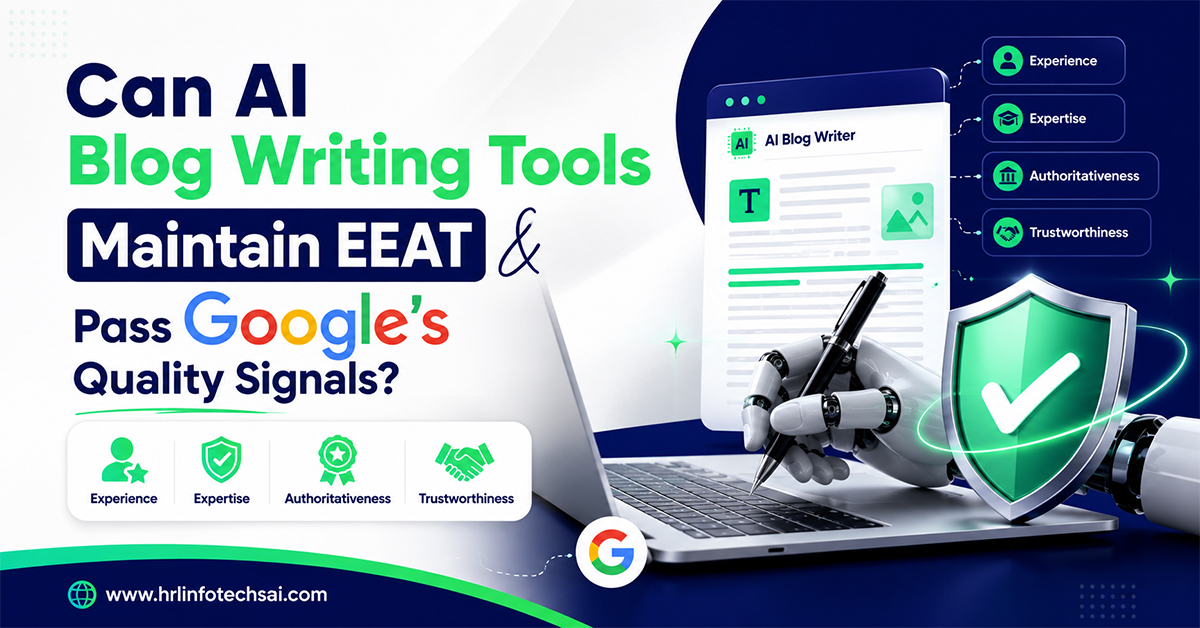
Google's E-E-A-T guidelines evaluate content across four dimensions: Experience, Expertise, Authoritativeness, and Trustworthiness. These standards appear in Google's Search Quality Rater Guidelines, a publicly available document that describes how Google's human quality raters assess whether content deserves to rank.
The critical clarification most Indian businesses miss: Google does not evaluate whether AI or a human produced the content. Google evaluates whether the content demonstrates the four E-E-A-T signals regardless of how it was produced. Google's own guidance, updated through the March 2024 helpful content system, states explicitly that AI-generated content is not inherently problematic; low-quality, unhelpful content is.
This distinction changes the entire conversation.
Why AI Content Faces Quality Concerns in India
Early AI content quality problems were real and visible. Generic articles that repeated the same five points found across the top ten search results. Content that mentioned "India" in the title but contained no India-specific data, examples, or context. Keyword-optimised paragraphs that answered no real question a reader had actually typed into Google.
Indian buyers and Indian search behaviour are specific. A blog about GST compliance that uses US tax terminology, or a fintech article citing American consumer behaviour statistics, fails the relevance test regardless of how well it is structured. Early AI tools produced this kind of generic output because they were not trained or prompted to produce anything else.
Modern AI content generation platforms operating with proper brand voice setup, Indian market context, and subject matter expert review produce content that Indian readers and Google's quality systems treat very differently.
Can AI Content Meet E-E-A-T Standards?
Each E-E-A-T component requires a specific response, not a general commitment to "quality."
Experience:
It requires content that reflects firsthand knowledge. For Indian businesses, this means specific client scenarios, named city contexts, regulatory situations that actually occur in the Indian market, and the kind of operational detail that comes from genuinely understanding the customer. AI generates the structure. A subject matter expert adds the scenario from last Tuesday's client call.
Expertise:
It requires accurate, specific information in the relevant domain. An AI SEO content strategy built around subject matter expert review, where a CA reviews financial content, a compliance officer reviews regulatory content, and a developer reviews technical content, produces expertise signals that generic AI output cannot. The AI drafts. The expert verifies, corrects, and adds precision.
Authoritativeness:
This is built through topical depth over time, not individual articles. Publishing interconnected content clusters across a topic, thirty articles about GST compliance, rather than one, signals to Google that a site is an authoritative source in that domain. AI-powered content marketing makes this volume achievable for Indian businesses that could not previously sustain it.
Trustworthiness:
This requires accuracy, verifiable claims, and content that does what it promises. Human editorial review before publication is the mechanism that delivers this, not the AI itself, and not the absence of AI.
The Role of Human Expertise
AI blog writing tools do not replace the judgment that makes content trustworthy. They replace the mechanical production work that consumes the hours, for which human judgment should be applied.
A single hour saved turns into sharper results when an Indian marketing lead swaps drafting time for deeper review. Instead of building from zero, she polishes raw material shaped by machine logic. What emerges blends precision with cultural nuance - something neither tool nor person could nail alone. Machines sort facts fast, weave frameworks neatly. Humans spot gaps, ground ideas where they matter most. Time bends differently now: less grinding, more shaping. Better outcomes rise quietly from that shift.
This is the combination of Google's quality systems reward.
Why Content Quality Matters More Than Content Source
That March 2024 shift by Google? It went after pages built for bots, not people - writer origin didn’t matter. Some Indian companies saw drops that year, true - but the trigger wasn’t AI tools. What mattered was what showed up: words on screen that looked like answers yet helped nobody who clicked through. Empty shells dressed as articles got pushed down. Real help stayed afloat.
AI content optimisation prevents this by ensuring that published content answers the specific question the target keyword represents, includes the contextual depth the Indian reader expects, and demonstrates through structure and specificity that an expert was involved in its production.
Optimising AI Content for Search Performance
Publishing a well-produced article is the beginning, not the end. SEO content automation ensures that content continues improving after publication, identifying which articles are approaching page-one rankings and need specific strengthening, which have outdated regulatory information that needs updating for the current Indian compliance environment, and which internal linking gaps are limiting the topical authority building across the content cluster.
Indian tax law changes. Indian regulatory requirements evolve. Indian market conditions shift. Content that was accurate in January may be misleading by October. Automated monitoring catches this systematically rather than depending on someone remembering to check.
How Automation Improves Consistency
The fintech startup's competitor, which published fourteen articles in six weeks, was not running a larger content team. They had implemented content marketing automation that handled scheduling. One task done, the system took care of posting updates, managing approvals, and checking results. Without needing reminders, it opened space for the writer to work closely with specialists, shaping stories instead of wrestling with calendars or chasing deadlines in the software.
Consistency is the mechanism through which topical authority accumulates. AI blogging for businesses makes consistency achievable for Indian teams whose previous publishing ceiling was constrained by production capacity rather than content strategy.
The Future of AI in Indian Content Marketing
Content marketing automation in India is accelerating because the economics are compelling and the quality gap between AI-assisted and purely manual content is closing rapidly for businesses that implement proper editorial oversight.
Indian businesses in competitive categories, such as legal, financial, healthcare, edtech, and D2C that build AI-assisted content operations with strong human review processes will accumulate organic authority faster than competitors who are still debating whether to start.
The internal debate the Bengaluru fintech startup was having is the wrong one. The question is not whether AI content can pass Google's quality standards. The question is whether your editorial process is strong enough to make it pass.
Conclusion
The fintech startup implemented an AI-assisted content system with subject matter expert review in March 2025. By August, they had published 38 articles, ranked for 29 new keywords, and organic search had become their second-largest lead source. Their competitor's six-week head start cost them approximately 400 organic leads they never recovered.
At HRL Infotechs AI, our platform is built specifically for the Indian market, combining source-backed AI content generation, automated publishing, subject matter expert review workflows, and continuous AI content optimisation to produce content that satisfies Google's E-E-A-T standards and genuinely serves Indian readers.
The answer to the original question: yes, AI content can pass Google's quality signals. Whether yours does depends on the system you build around it.