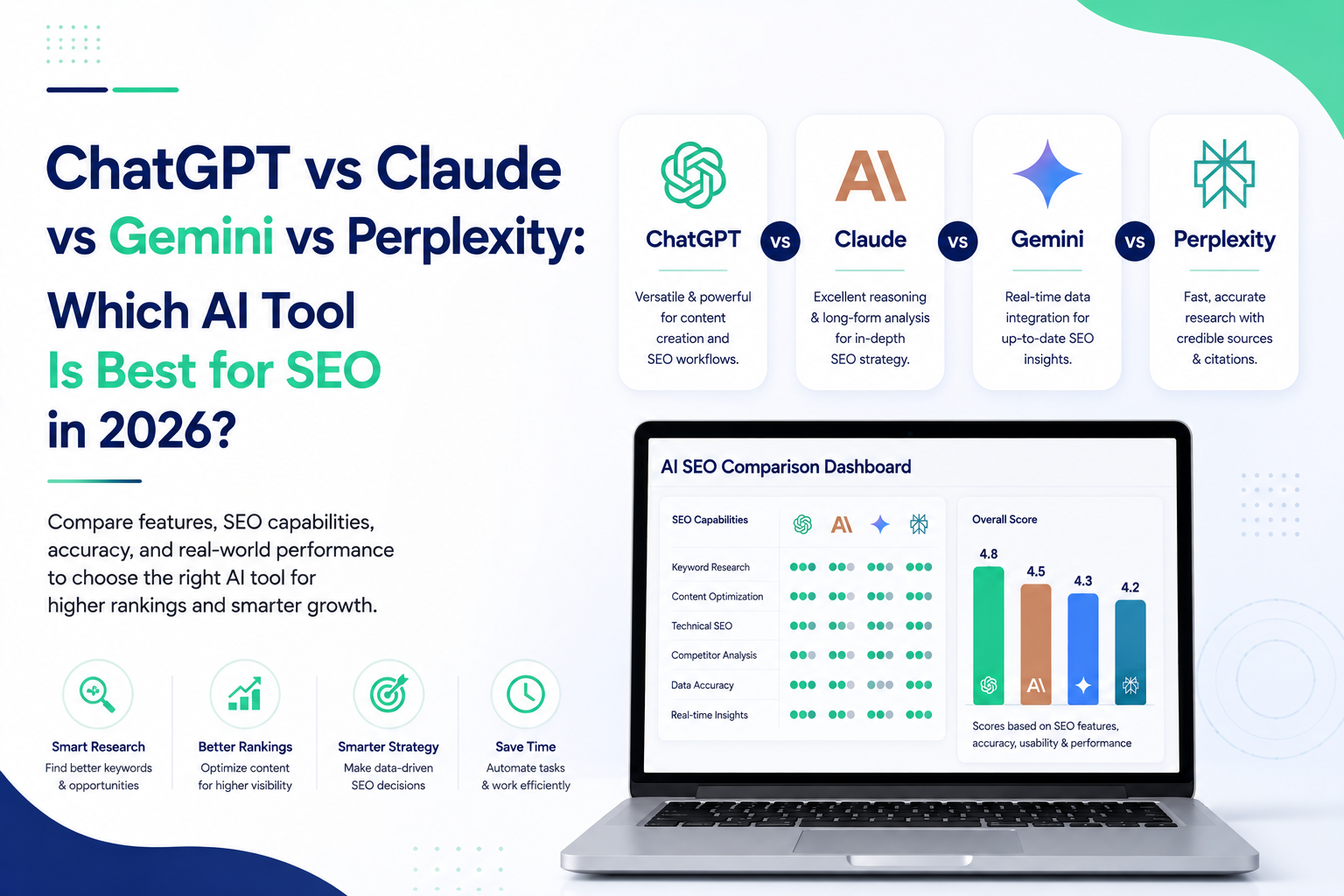
AI has changed the way businesses research keywords, create content, analyze competitors, and optimize websites. In 2026, marketers are no longer asking whether they should use AI for SEO. The bigger question is which AI tool is best for SEO.
ChatGPT, Claude, Gemini, and Perplexity each approach SEO differently. Some are stronger at content creation, others at research, and some are particularly useful for understanding search results and finding fresh sources. The right choice depends on whether your priority is content writing, keyword research, competitor analysis, AI search optimization, or building a scalable SEO workflow.
For Indian businesses, agencies, e-commerce brands, and startups, understanding these differences can help reduce content-production time while improving the quality and relevance of SEO campaigns.
AI Tools for SEO: What Should You Actually Look For?
The best AI SEO tools are not simply the ones that generate the longest articles. A useful SEO workflow requires several capabilities: understanding search intent, researching topics, creating useful content, identifying keyword opportunities, optimizing existing pages, analyzing competitors, and adapting content for AI-powered search.
Modern AI tools have also moved beyond static knowledge. ChatGPT can use web search and Deep Research to gather current information and produce cited research. Claude offers web search and Research capabilities that can conduct multiple searches and provide citations. Gemini also provides Deep Research for multi-step web research, while Perplexity is built around conversational search with citations and links to original sources.
This makes the comparison less about “which AI writes best?” and more about which AI is best suited to a particular SEO job.
ChatGPT for SEO: Best Overall SEO Assistant
ChatGPT is arguably the most versatile option for SEO teams because it can support almost every stage of the content workflow.
For ChatGPT for SEO, marketers can use it for keyword clustering, search-intent analysis, content briefs, outlines, blog writing, title and meta-description ideas, FAQs, content refreshing, schema planning, internal-link suggestions, and competitor analysis.
Its web search capability is particularly useful when SEO research depends on current information. Deep Research goes further by conducting multi-step research across sources and producing a documented report with citations.
ChatGPT is especially effective when you give it detailed context. Instead of asking it to “write an SEO blog,” provide the target audience, primary keyword, secondary keywords, competitors, search intent, brand voice, internal pages, and conversion goal.
Best for:
Content strategy
Blog and landing-page creation
Keyword clustering
Content optimization
SEO research
AI search optimization
Creating repeatable SEO workflows
Verdict: If you want one flexible AI assistant for multiple SEO tasks, ChatGPT is the strongest overall choice.
Claude for SEO: Best for Long-Form Content and Refinement
Claude is particularly valuable when the quality, structure, and readability of long-form content matter.
Claude for SEO can help marketers transform rough research into organized articles, improve existing drafts, simplify complex explanations, and maintain a consistent editorial voice. Its Research feature can perform multiple searches across the web and connected sources, then provide citations in the resulting answer.
Claude can be useful during the editing stage of SEO. For example, an SEO team can provide an existing 2,000-word article and ask Claude to identify repetitive sections, weak explanations, missing questions, unclear transitions, or opportunities to make the content more useful.
However, Claude should not be treated as an autonomous SEO strategist. It still needs accurate keyword data, competitive analysis, and human editorial judgment.
Best for:
Long-form content
Editing and rewriting
Content quality improvement
Research-heavy articles
Brand voice refinement
Content analysis
Verdict: Claude is an excellent choice when content depth, readability, and refinement are more important than building an entire SEO workflow around one tool.
Gemini for SEO: Best for Google Ecosystem and Research
Gemini has a major advantage for businesses already working heavily inside Google's ecosystem.
Gemini for SEO can be useful for research, brainstorming, content analysis, and understanding information across Google's productivity environment. Gemini's Deep Research is designed to break complex prompts into research questions, analyze relevant websites, and create comprehensive reports. Google's 2026 updates have also expanded its autonomous research capabilities.
For marketers, Gemini can be useful when developing content briefs, researching trends, analyzing large amounts of information, and turning research into structured content.
It is particularly attractive for teams that already rely extensively on Google Workspace and want AI-assisted workflows around their existing business information.
Best for:
Research
Google ecosystem workflows
Content ideation
Large information sets
Competitive and market research
Content planning
Verdict: Gemini is a strong option for research-driven SEO teams, especially businesses deeply integrated with Google's ecosystem.
Perplexity for SEO: Best for Search and Source Discovery
Perplexity takes a different approach. Rather than primarily positioning itself as a writing assistant, it operates as an AI-powered search engine that provides conversational answers backed by citations and links to original sources.
That makes Perplexity for SEO particularly useful during research.
SEO professionals can use Perplexity to discover competitors, identify frequently discussed topics, find supporting sources, investigate industry developments, and explore questions related to search intent.
For example, instead of starting content research with a keyword such as “AI SEO tools,” an SEO strategist could ask Perplexity what businesses commonly want to know before choosing an AI SEO platform. The resulting questions can then become content angles, FAQs, comparison sections, or supporting topics.
Perplexity is therefore particularly valuable at the research and discovery stage, although you may still want another AI platform for producing and optimizing the final content.
Best for:
Web research
Source discovery
Competitor research
Topic exploration
Fact checking
Search-intent research
Verdict: Perplexity is one of the strongest choices when your priority is discovering information quickly and verifying sources.
ChatGPT vs Claude vs Gemini vs Perplexity: Quick Comparison
AI Tool | Strongest SEO Use | Content Writing | Research | Optimization | Best For |
|---|---|---|---|---|---|
ChatGPT | Complete SEO workflow | Excellent | Excellent | Excellent | Overall SEO |
Claude | Long-form refinement | Excellent | Excellent | Very good | High-quality content |
Gemini | Research + Google ecosystem | Very good | Excellent | Very good | Research-driven SEO |
Perplexity | Search and sources | Good | Excellent | Good | SEO research |
The important point is that there is no single winner for every SEO task. A content writer may prefer Claude, an SEO strategist may prefer ChatGPT, a research-heavy marketer may choose Gemini, and a researcher may rely heavily on Perplexity.
Which AI Is Best for Content Optimization?
If the goal is the best AI for content optimization, ChatGPT has the broadest practical use because it can combine content creation, search-based research, structured analysis, and optimization within one workflow.
For example, an SEO team can use it to:
Analyze the existing page.
Identify the search intent.
Compare competing pages.
Find content gaps.
Suggest related entities and questions.
Improve headings and structure.
Rewrite weak sections.
Create FAQs and metadata.
Suggest internal links.
Adapt the content for AI search visibility.
Claude can then be useful as a second editorial layer, while Perplexity or Gemini can provide additional research and source discovery.
AI Search Optimization and GEO Optimization in 2026
Traditional SEO focuses heavily on visibility in search engine results. AI search optimization, often called GEO optimization, adds another objective: making content easier for AI systems to understand, retrieve, summarize, and potentially cite.
That changes how businesses should create content.
Instead of writing pages purely around exact-match keywords, brands should answer specific questions, demonstrate expertise, provide original information, use clear structures, cite credible sources where appropriate, and build topical depth across related subjects.
This is where AI tools can complement traditional SEO rather than replace it.
For example, Perplexity can help identify questions users are asking. ChatGPT can turn those questions into content clusters and structured briefs. Claude can refine the resulting articles. Gemini can support broader research.
The strategy is therefore not AI SEO vs traditional SEO. In 2026, effective SEO combines technical SEO, keyword strategy, helpful content, authority, user experience, and optimization for AI-powered discovery.
What Is the Best AI Tool for Content Writing?
If your primary objective is the best AI tool for content writing, there is no universal answer.
Choose ChatGPT when you want versatility, SEO structure, research, and scalable workflows.
Choose Claude when you have substantial drafts that need strong writing, editing, and refinement.
Choose Gemini when research and Google-oriented workflows are central to your process.
Choose Perplexity when you need to research a topic and quickly discover credible sources before writing.
The smartest approach may actually be to use different tools for different stages rather than forcing one platform to do everything.
How Businesses Can Scale SEO With AI
Using individual AI tools can improve productivity, but businesses often face another problem: fragmented workflows.
Keyword research happens in one tool. Content is generated somewhere else. SEO optimization happens separately. Publishing is manual. Rankings are checked later. Internal links are forgotten.
An integrated workflow can solve this problem.
HRL Infotechs AI combines AI-powered content creation, keyword tracking, content strategy, SEO optimization, and automated publishing in one platform. Its Content Engine generates SEO-focused blogs and landing pages, while the Keyword Tracker helps identify ranking opportunities and monitor competitors.
For businesses that want to automate publishing, the AI Blog Agent can handle keyword research, content creation, SEO metadata, internal links, and publishing directly to a connected website.
This approach is particularly useful for Indian businesses that need consistent organic visibility without continuously expanding their content team.
Final Verdict: Which AI Tool Is Best for SEO in 2026?
So, which AI tool is best for SEO in 2026?
ChatGPT is the best overall AI tool for SEO because of its versatility across research, content creation, optimization, and strategic workflows.
Claude is the best choice for long-form writing and editorial refinement.
Gemini is excellent for research and Google-centric workflows.
Perplexity is one of the best tools for search-focused research and source discovery.
But the bigger SEO opportunity is not choosing one AI tool. It is building a system where AI supports research, strategy, content production, optimization, publishing, and measurement while humans remain responsible for expertise, accuracy, originality, and business strategy.
For businesses serious about organic growth, AI should not replace SEO strategy. It should make a good SEO strategy faster, more consistent, and easier to scale.
If you want to move beyond individual AI prompts and build a repeatable SEO content system, explore HRL Infotechs AI's AI-powered content engine and automated SEO workflow to create, optimize, and publish content at scale.