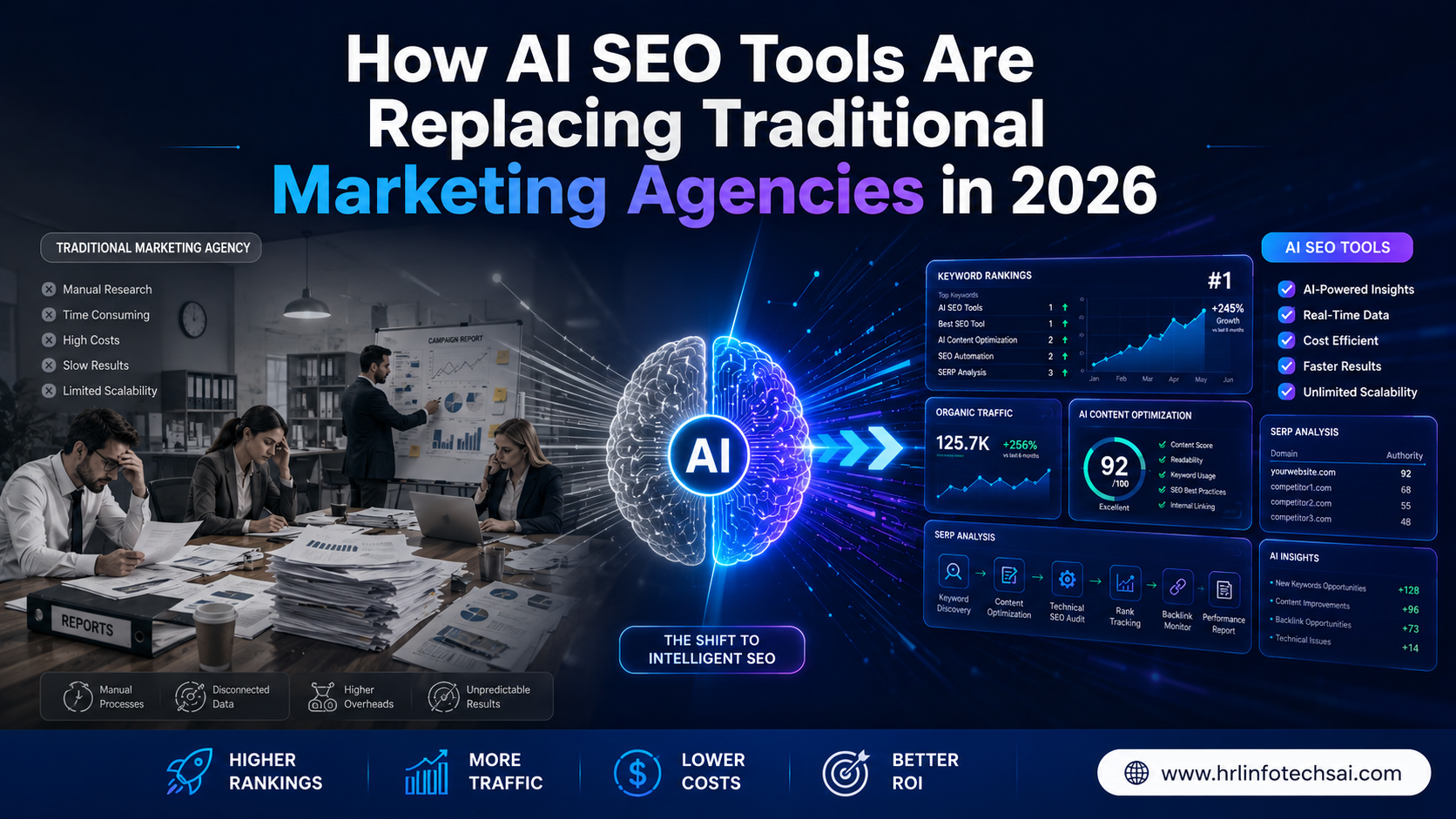
The relationship between businesses and marketing agencies is changing. These days it’s less about agencies losing value - plenty still deliver - and more about how tightly matched human teams are to smart tools. Software learns faster now, closing ground on tasks once reserved for experts. By 2026, even small companies will pause before hiring outside help. The old default hire-out approach stumbles. Real work gets done internally first. Outsourcing feels like a second thought, not a starting point. What used to be automatic now demands justification.
The answer is driving rapid adoption of AI SEO tools across industries where organic search performance directly determines revenue. And the businesses moving fastest are not the largest ones with the biggest budgets. They are the ones willing to rethink how marketing work gets done.
Why Traditional Agency Models Are Facing Real Pressure
Most businesses know hiring a marketing firm costs plenty. Slow progress shows up early - fees each month, setup waits, slow approvals, reports trickling in later than needed. When your world moves quickly, waiting feels like falling behind. That lag? It turns into real trouble.
When a competitor adjusts their content strategy on a Monday, and you find out through your agency's Friday report, you have already lost a week. In competitive search environments, a week matters.
This is where AI-powered SEO software changes the dynamic. Instead of waiting for human analysts to compile data, review rankings, and schedule a call to discuss findings, businesses can access the same quality of insight in real time and act on it immediately. The speed advantage alone is enough to justify adoption for many organisations, before cost savings even enter the conversation.
What SEO Automation Actually Handles Now
The term automation gets overused, but in the context of modern SEO automation tools, it is worth being specific about what actually runs without human input today.
Keyword tracking across thousands of terms. Before problems hit search positions, tech checks catch them early. When a competitor drops fresh content or grabs strong links, tracking lights up. Reports keep pace with real-time shifts instead of waiting weeks. Content gap analysis that identifies exactly what topics are missing from a site's coverage.
None of this requires a person sitting in front of a screen anymore. The platforms handle it, surface the findings, and present recommendations that a marketer or business owner can act on directly.
How AI Is Reshaping Digital Marketing Beyond Search
AI digital marketing tools have expanded well past SEO into virtually every channel where data drives decisions.
Audience segmentation that once required a data analyst now runs automatically. Content performance predictions based on historical engagement patterns help teams prioritise what to create before investing production time. Customer behaviour modelling surfaces patterns that no human analyst reviewing the same dataset would reliably spot.
The practical result for marketing teams is a fundamental shift in where their time goes. Less time processing data. More time making decisions with it. Most of them think it’s simple - until they try. Yet doing it reshapes what teams can pull off, even without extra people on board. The workload stays put, yet outcomes stretch beyond old limits.
The Platforms Doing the Heaviest Work in 2026
Peering into company toolkits shows shifts in human-machine roles. What teams actually use daily reveals new patterns in oversight and trust. Specific software choices highlight evolving responsibilities between creators and systems.
Surfer SEO has become the standard when shaping their content, comparing drafts directly to leading pages as they write, getting clear suggestions instead of vague advice. Since teams began using it, rankings often improve more quickly - decisions come easier without second-guessing each edit
Semrush operates as a full marketing intelligence platform, where checking rivals blends into planning articles. Teams once handing off reports to outside firms might now skip those middle steps entirely. Instead of waiting on third parties, everything pulls together directly - no extra layers needed.
Ahrefs remains the most respected tool for backlink analysis and content research. Its ability to surface keyword opportunities with realistic ranking difficulty assessments helps businesses prioritise effort toward terms they can actually compete for, rather than aspirational targets that drain budget.
ChatGPT has permanently changed content production economics. Used properly as a research and drafting accelerator rather than a replacement for editorial judgment, it enables content teams to produce significantly more output without a proportional increase in headcount.
HRL.AI addresses the full workflow challenge that individual tools often leave unsolved. Rather than requiring businesses to connect multiple platforms manually, HRL.AI integrates SEO intelligence, content automation, and performance tracking into a unified system designed specifically for businesses that need to scale digital growth without scaling team size proportionally.
Where AI Content Optimisation Is Creating the Biggest Gains
Content is where most SEO strategies either succeed or stall. Publishing consistently, targeting the right topics, structuring articles correctly, and aligning with current search intent simultaneously is genuinely difficult to sustain manually at scale.
AI content Writing & optimisation tools solve different parts of this problem depending on how they are used. At the research stage, they identify what a piece needs to rank related topics, semantic terms, and structural recommendations before a writer begins. Midway through writing, issues pop up instantly alongside smart tweaks. Once live, shifts in how people search reveal where updates fit best - quiet signals guiding what grows next.
Starting strong means fewer fixes later on. When pieces grow steadily, thanks to steady guidance, they gain worth at a steadier pace. Content built this way outperforms work made without structured help right from the start.
Why Smaller Businesses Are Gaining Ground
One of the least-discussed consequences of AI adoption in marketing is what it has done to the competitive gap between large and small organisations.
AI SEO solutions for businesses of all sizes have effectively removed the advantage that enterprise companies once held simply by having larger marketing departments. A company that has 10 members with efficient tools can now implement keyword research, technical auditing, content optimisation, and performance monitoring with the standard that previously required a bunch of members and a dedicated team.
What we’re seeing isn’t just a small step forward. A real change has taken hold - reshaping which companies stand out in search results - and that’s why leaner, quicker firms now pass bigger rivals online even with far less money to spend.
Staying Ahead of Algorithm Changes Without a Dedicated Team
Search engine algorithms do not change at times that depend on marketing departments' schedules. Updates arrive on their own schedule, and the businesses that respond quickly will suffer the least.
Automated SEO tools enable proactive monitoring for organisations that could not previously afford a team to continuously monitor performance. When ranking drops appear, businesses receive alerts before traffic losses compound. When technical issues emerge, they surface in audit reports before they reach a scale that affects conversions.
The competitive advantage here is not just cost; it is responsiveness. A business that knows about a ranking shift on day one is in a fundamentally better position than one that discovers it three weeks later during a monthly review.
How Agencies Are Adapting Rather Than Disappearing
The honest version of this conversation is not about replacement. Most businesses using AI marketing automation software effectively are not cancelling their agency relationships. They are changing what they ask agencies to do.
Routine processes: keyword tracking, software quietly handles keyword checks, reports, audits, and performance updates. Instead of those tasks, teams now lean into big-picture thinking - shaping brands, guiding creative choices, finding market fit - work that needs real insight, not just data parsing.
Outcomes often improve when roles shift like this. Instead of clocking time on routine jobs, agencies let software take over - speedy, precise, fewer errors. Firms no longer charge high fees for basic tasks better done elsewhere. With old habits gone, the partnership leans into bigger thinking. Those who adjust find a steadier path forward.
Can AI Replace Traditional Marketing Agencies?
The debate around whether AI will replace traditional marketing agencies misses the more useful question: what should your marketing operation actually look like if you build it around what AI does well?
Some companies need more tech help than others. Depending on how big they are, what field they’re in, or how fast they grow, needs shift. Still, nearly every team begins the same way. Look closely at tasks done today by experienced people. Spot those that clever programs might take over instead. Free up those workers. Let them focus on thinking deeply, solving tricky issues, and shaping ideas only humans can build.
That reallocation, done thoughtfully, is what separates businesses that use AI as a cost-cutting tool from those using it as a genuine growth accelerator.
CONCLUSION
Search visibility in 2026 is not won by the businesses with the biggest agency relationships. It is won by the ones that make better decisions faster, based on better data, with less operational overhead slowing them down.
AI has made all three of those things more accessible than they have ever been. The tools exist. The workflows are proven. The businesses seeing results are the ones that stopped waiting for a perfect implementation plan and started building.
At HRL.AI, we help businesses move from that starting point to a fully operational AI-driven marketing system, one that delivers consistent SEO performance, reduces dependency on manual processes, and creates the kind of compounding digital growth that becomes genuinely difficult for competitors to close. The advantage builds over time. The time to start building it is now.