Every marketing team eventually hits the same wall. Content production scales up, and consistency falls apart. One blog reads like a thought leadership piece from a senior strategist. The next sounds like it was written by an intern on a Friday afternoon. The one after that could belong to a competitor. When businesses start using AI to accelerate output, this problem does not disappear; it compounds. AI writes fast. It does not automatically write like you.
This is why AI brand voice training has become the operational priority. This changes everything. Now, teaching AI your brand's way of speaking isn’t just another task - it’s what splits ordinary output from work that sticks in minds and earns confidence, even when made fast and often. People aren’t asking if machines can form sentences anymore. They’re watching to see if those sentences sound like you, exactly. That only happens if you clearly show the machine who you are.
Why Brand Voice Matters More Than Ever
One company might sell the same tool to the same people using the same keywords as another. Yet the one remembered by return visitors often stands out simply because its words sounded familiar - steady in tone, clear in intent, human enough to believe. Recognition builds when phrasing stays true over time, not just when it’s visible in ads or rankings.
Brand voice consistency is not a stylistic preference. One thing is clear: keeping a steady way of speaking isn’t just about looks. It builds value straight into the business. Pages that match in how they sound - blogs, messages, sign-up spots - add up to familiarity, bit by bit. If tones jump around, each new piece feels like a stranger showing up again and again. Trust never stacks; it resets every single time. Pushing out more material before fixing that? Just floods the space with louder silence.
What AI Learns From Your Existing Content
Modern AI content writing tools do not simply generate text from a topic prompt. They identify and replicate patterns: sentence rhythm, vocabulary preferences, how claims are qualified, how examples are introduced, and whether the brand argues boldly or hedges carefully.
When your current writing sticks to one way of sounding, artificial intelligence picks up on that rhythm and follows along. A jumble of three separate tones across what you’ve shared - without any clear rule for how things should sound - teaches machines to mirror the chaos instead.
That's the reason why AI content generation quality is counted in downstream content quality. Businesses that want AI-written content first understand the steps of automated content generation and document the requirements.
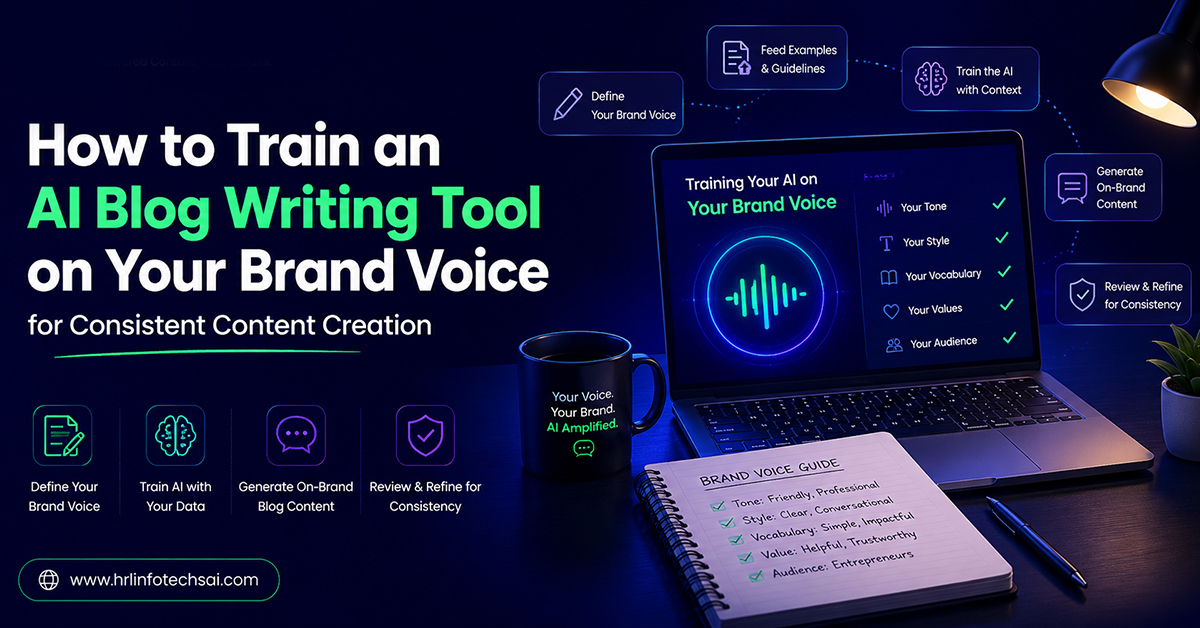
Step 1: Create a Brand Voice Document With Real Examples
Most brand voice documents fail because they describe qualities without demonstrating them. Writing "our tone is professional but approachable" tells an AI nothing specific. Showing the difference does.
Generic: "Our platform helps businesses improve content efficiency."
Brand voice: "Most teams we work with recover eight to twelve hours per week in their first month. The work does not disappear; it just stops requiring a human to do it manually."
Your document should include specific sentence examples for each tonal quality, a vocabulary list of words you use and avoid, paragraph length preferences, and how you open articles. These specifics become the foundation for effective AI-powered content marketing, not abstract descriptions of how you want to sound.
Step 2: Train AI Using Your Best Existing Content
The most effective AI blog-writing tools learn from examples, not from instructions alone. Select your five to eight best-performing published articles and feed them as reference material alongside every new content prompt.
Instead of: "Write a blog about content marketing for SaaS companies."
Use: "Write a blog about content marketing for SaaS companies. Match the tone, sentence structure, and vocabulary of these three reference articles."
The AI moves from producing generic category content to producing content that feels like it came from your team. This single prompting change typically delivers more improvement than any platform feature or setting.
Step 3: Build Reusable Prompt Frameworks
Writing new instructions for every article is how prompt quality drifts and brand voice consistency breaks down over time.
Build a reusable prompt framework that includes your audience description, tone guidance with examples, vocabulary inclusions and exclusions, how you want claims supported, and links to 2 or 3 reference articles. Save this as a template that opens every content session.
Starting strong with consistency, each piece flows from your AI-powered content marketing workflow, where different people run the system or tackle unrelated subjects. Built right, the structure keeps the tone steady across all outputs.
Step 4: Establish Editorial Rules That Protect Voice at Scale
Specific rules produce better results than general guidance.
General: "Keep the tone conversational."
Specific: "Never open a paragraph with 'It is important to note.' Never use 'leverage' as a verb. Keep paragraphs to four lines maximum. Open each section with a specific claim, not a general industry observation."
These rules support AI content optimisation by providing editors with a precise checklist rather than a subjective quality call. Editors stop rewriting entire articles and start making targeted refinements. Review time drops. Consistency improves.
Step 5: Use AI to Scale Without Losing Identity
Once the voice infrastructure is in place, content marketing automation ceases to be a quality risk and becomes a genuine growth lever.
Founders used to struggle to publish one high-quality article a month; now AI enables eight by handling the structuring and research. Authentic human touch comes from the founder’s personal stories, insights, and unique perspective. Even when managing multiple products, smart prompt design keeps brand voices completely distinct by automatically adjusting tone before the writing begins.
This is what AI blogging for businesses should actually deliver: not more generic content faster, but more of your specific content faster.
Why Human Oversight Still Matters
AI blog writing tools do not replace the judgment that makes content genuinely useful. Most of what feels real in writing still comes from people, not machines. Getting facts together, shaping outlines, drafting pages - these tasks move faster with artificial help. A lived experience connects better than any algorithm can guess. Spotting mismatched tones hides behind correct sentences now and then.
True authority shows up when depth matters more than surface checks. Published work earns trust by reflecting actual understanding, never just borrowed answers. The most effective AI blogging for businesses implementations treat AI as the production layer and human editorial judgment as the quality layer. Neither replaces the other.
Common Mistakes That Destroy Brand Voice Consistency
Skipping the brand voice document. Without documented examples, AI defaults to generic category writing, immediately training on mediocre content. AI learns what you give it. Curate your best work specifically, not your average output.
Changing prompt frameworks between sessions. Inconsistent instructions produce inconsistent output. Build the framework once and protect it. Publishing raw AI output without review. The fastest way to damage credibility with a professional audience is to publish content that reads as unreviewed AI-generated.
Prioritising volume before voice is established. Thirty inconsistent articles require retroactive correction. Do the voice work first.
Conclusion
AI brand voice training is not a one-time setup. It is an ongoing system: reference content is updated as the brand evolves, prompt frameworks are refined as AI improves, and editorial rules are tightened as the team learns where the tool needs correction.
The businesses building lasting content advantages are not the ones publishing the most articles. They are the ones whose readers recognise them by the third sentence without checking the byline.
At HRL Infotechs AI, our platform supports exactly this system: brand voice onboarding, reference content integration, prompt framework templates, and editorial workflow tools designed to make your content sound like you at whatever scale your business requires.
Because the future of content is not about sounding like AI is about making AI sound like you.