A marketing head at a Pune-based B2B SaaS company shared a problem that most Indian growth teams will recognise immediately.
Their team was producing two blogs per week, posting daily on LinkedIn, sending fortnightly email campaigns, and updating landing pages every quarter. Traffic was inconsistent. Leads from organic search were negligible. The content director could not explain why one article drove 400 visits, and the next drove 11, despite similar topics and identical effort. The issue was not a lack of content. Their team was working harder than most.
The issue was that every piece of content existed independently. No article informed the next. No performance data shaped future decisions. No system connected research to creation to optimisation to growth. They were producing content in a straight line, which means every month started from zero momentum.
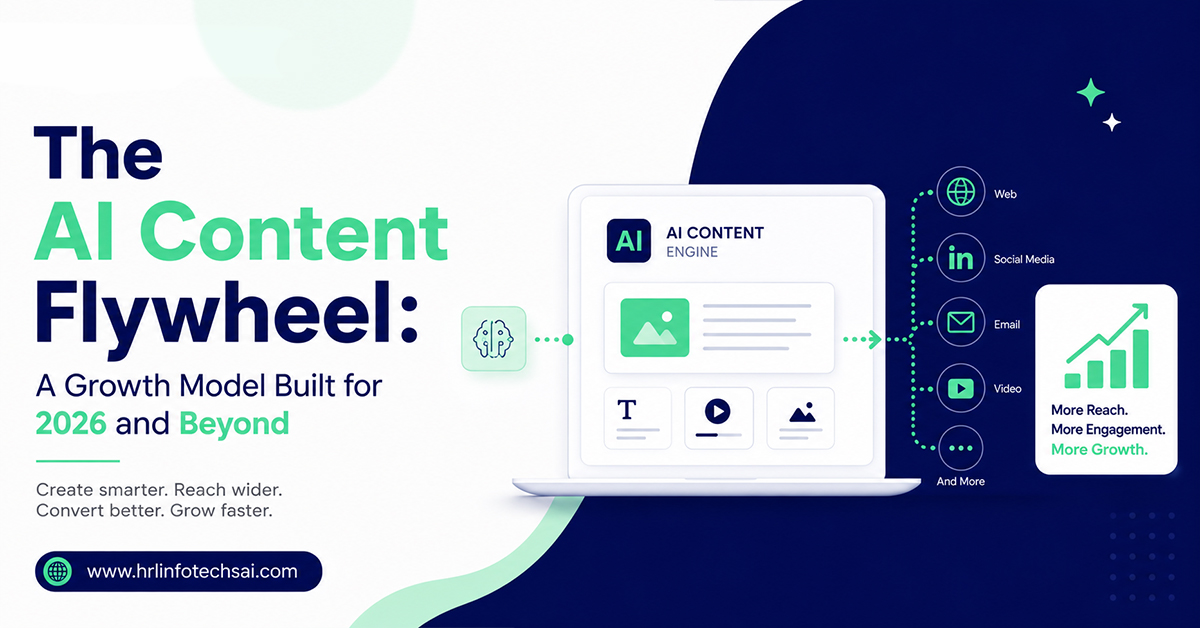
This is why the AI content flywheel has become the growth model Indian businesses are building their content operations around in 2026. Instead of treating content as individual campaigns, companies build systems where every article, keyword, customer question, and performance insight continuously improves the next piece. The result is compounding growth rather than inconsistent spikes.
Why Traditional Content Models Are Breaking Down
India's digital content market has changed dramatically in three years. More Indian businesses are publishing SEO content than ever before. Competition for organic visibility in categories like fintech, healthtech, edtech, D2C, and professional services has intensified to the point where the old linear approach, research, write, publish, forget, repeat, produces results that are increasingly difficult to justify as a business investment.
AI-powered content marketing changes this model entirely. Every published article generates data that informs subsequent decisions. Every ranking improvement reveals adjacent opportunities. Every customer search query that surfaces in analytics becomes a future content brief. The system learns and improves continuously rather than resetting with every new article.
That accumulation of learning is the flywheel. Once it starts spinning, it accelerates.
Stage One: Research and Discovery
Every effective content system begins with understanding what Indian buyers in your specific category are actually searching for, not what marketing teams assume they are.
AI content generation platforms analyse search patterns. Searching online looks different depending on where people live. One tool monitors what users click, identifies weak spots in rival articles, tracks emerging topics in India, and spots useful words for both local and nationwide searches at once. Take a law company in Bengaluru aiming at small businesses. Their material must match how Indians ask about legal support - because those phrases often do not sound like questions typed by professionals in Britain or America.
The more precisely the research phase maps to real Indian buyer behaviour, the stronger every subsequent stage of the flywheel becomes.
Stage Two: Creating Content at Scale
Producing consistent content has historically required either large teams or inconsistent output from small ones. Most Indian marketing teams are small. Most Indian content budgets are constrained. The production ceiling has been the primary reason Indian companies could not compete with category leaders on content volume.
AI blog writing tools remove this ceiling without removing the editorial judgment that makes content worth reading. Content teams generate article structures, topic outlines, first drafts, meta descriptions, and internal linking suggestions in a fraction of the time these tasks previously required. Writers spend their hours on the work that requires genuine expertise- adding specific Indian market examples, customer scenarios, regulatory context, and strategic perspective that no AI produces without human direction.
The Pune SaaS team moved from two articles per week to nine without adding headcount. Their per-article production time dropped from six hours to ninety minutes.
Maintaining Brand Voice Across Every Channel
One thing happens when output grows - tone splinters. Different people, teams, even machines start writing without matching rhythm. Each message feels like it comes from another version of the same business. That mismatch? It quietly wears down confidence. Trust forms slowly. Inconsistency breaks it faster.
Brand voice consistency in an AI-assisted content operation requires deliberate infrastructure. Start with what already works. Some Indian firms feed polished past content into AI tools so the machine learns the right tone. Word choices get locked down ahead of time, matching how real customers talk. Rules guide every piece, whether human hands shaped it or software did. Structure comes before speed. Consistency shows up when systems follow clear patterns, not luck.
Consistency turns content into a recognisable brand asset. Inconsistency turns it into noise.
The Role of AI Blog Writing Platforms
AI blog writing tools in 2026 function as content accelerators, not content replacements. The distinction matters practically.
Most Indian readers spot robotic AI writing fast, especially when marketers skip human oversight. Because of this, posts lacking a real voice lose attention just as quickly. When teams let algorithms manage only drafts and data sorting, yet keep people steering the meaning, something shifts. Insight shaped by locals travels further. Context rooted in experience gains traction online without forcing it. Trust grows quietly where relevance already lives.
The flywheel requires both components to operate together.
Building an Efficient Content Engine
Content marketing automation handles the operational layer that manual processes cannot sustain at scale: publishing schedules, workflow management, performance reporting, content distribution, and systematic update cycles for existing articles.
One task after another piles up when Indian marketing groups handle many formats, platforms, and paths at once. Machines keep things steady even when people slow down. Effort doesn’t stop just because someone gets busy elsewhere. Momentum builds by itself instead of waiting on one person to push. Work keeps moving whether energy is high or low.
Why SEO Is Central to the Flywheel
An AI SEO content strategy ensures that content production builds cumulative search authority rather than generating isolated pieces that compete with each other for the same rankings.
Topic clustering: publishing interconnected articles that collectively build authority around a subject, rather than targeting isolated keywords, is how Indian brands in competitive categories establish organic visibility that compounds over months. Each article strengthens the internal link structure. Each new ranking creates adjacent keyword opportunities. Each improvement in topical authority makes subsequent content rank faster with less promotional effort.
This compounding effect is what makes the flywheel structurally different from a linear content calendar.
Continuous Improvement Through Optimisation
AI content optimisation identifies the articles already generating some traffic that are close to significantly better rankings, pages sitting in positions eight through fifteen that need specific improvements rather than replacement.
For Indian businesses with constrained content budgets, improving an existing article that already has ranking momentum consistently outperforms the equivalent investment in new content production. The flywheel accelerates because every optimisation strengthens the assets already in motion.
Why Indian Businesses Are Adopting This Model
The Indian companies, seeing the strongest organic growth from AI blogging for businesses, are not publishing the most content. They are publishing within systems that improve with every piece produced.
Each article generates data. Each ranking reveals an opportunity. Each customer search that appears in analytics becomes next month's content brief. Over two or three quarters, this compounding process creates a content operation that smaller teams can sustain without large departments, and that becomes progressively more difficult for competitors to close the gap on.
Conclusion
The Pune SaaS team's organic traffic is now their second-largest lead source after referrals. It took them six months of flywheel operation to reach that position. The first two months produced modest results. Month three produced the first meaningful organic leads. By month six, the system was producing more consistently than their paid channels at a fraction of the cost per lead.
At HRL Infotechs AI, we help Indian businesses build exactly this content flywheel, combining AI-powered content marketing, automated publishing, SEO-driven topic clustering, and continuous optimisation into a growth system that strengthens with every article published.
By 2026, Indian companies crafting content engines won’t just release more material. Instead, their systems grow tougher to match - each passing quarter widening the lead over rivals.