There is a conversation happening inside marketing agencies right now that was not happening three years ago. It is not about whether content matters; everyone agrees it does. It is about whether the way agencies have always produced content is still the right way to produce it.
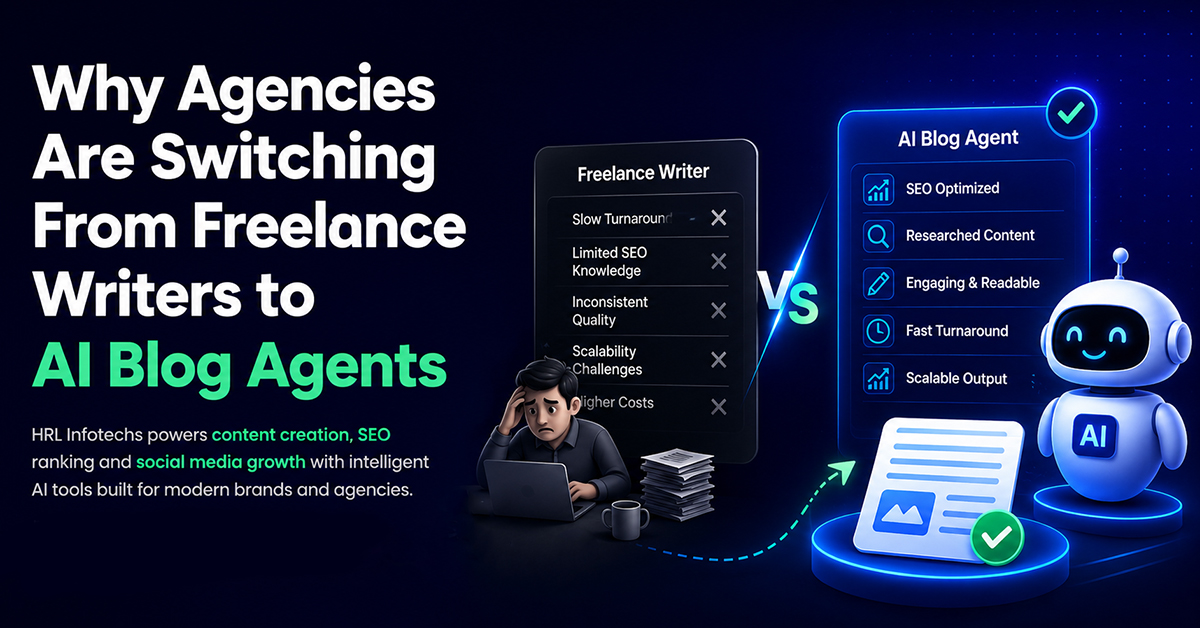
For most agencies, that means taking an honest look at the freelance model. Freelancers built the content industry as we know it. They still produce some of the best writing available. But as client demands scale upward and publishing schedules tighten, the limitations of coordinating distributed writers across dozens of accounts are becoming harder to absorb. This is why AI blog agents are entering agency workflows not to replace good writers, but to handle the parts of the process that never needed a creative human in the first place.
The Growing Challenge of Traditional Content Production
The challenge is not freelancer quality. Most agencies work with skilled writers who understand their subject matter and deliver solid work. The challenge is the operational layer surrounding that work.
Consider what happens before a writer starts. Every piece of writing. First, a subject must be picked - shaped by audience curiosity, mapped through competitor examples, clarified in a short outline, tied to keyword goals. Next comes the first version. It waits for adjustments: tweaks for clarity, checks for voice consistency, improvements for visibility online, adaptation into webpage structure, and placement on the calendar. Multiply this cycle across thirty weekly assignments for different brands. The workload doesn’t just add up - it weaves itself into knots, tightening as more clients join the list.
Freelancers bring expertise. They cannot change the fact that briefing, coordination, revision management, and SEO alignment still consume hours that agencies struggle to absorb at scale. That is where the pressure is. That is what is changing.
What AI Blog Writing Tools Actually Do in an Agency Context
The popular image of AI content tools is a machine writing articles autonomously. The reality of how effective agencies are using AI blog writing tools is more nuanced and considerably more useful.
The highest-value applications are in the structural work surrounding writing, not replacing writing itself. AI handles topic research and clustering, competitive gap analysis, keyword intent mapping, outline generation, and first-draft creation. What this produces is not a finished article. It is a strong starting point that a human editor or strategist can refine in a fraction of the time it would take to build from zero.
The result is a different division of labour. Human expertise applies where it genuinely matters: shaping the argument, adding original perspective, and ensuring the content reflects the client's voice. AI handles the groundwork that was always mechanical, just time-consuming.
Why Agencies Are Investing in AI Content Automation
The economics of traditional agency content production follow a straightforward pattern: more clients means more writers, more project managers, more coordination overhead, and eventually more operational complexity than the revenue justifies. AI content automation breaks this pattern.
Agencies that have integrated automation into their content workflows consistently report the same shift. The volume of content they can produce does not scale linearly with headcount anymore. Research, briefing, outlining, and first-draft creation happen faster. Editors review and refine rather than build from scratch. The same team that previously managed eight content clients can manage fifteen, not because they are working harder, but because the mechanical layer of production is no longer consuming the majority of their hours.
This is automation's scalability argument, and it's why agencies are adopting it faster.
How Automated Blog Writing Software Removes the Production Ceiling
Every agency has a content ceiling, a point where taking on additional clients would require hiring proportionally, eating into the margins that make growth worthwhile. Automated blog writing tools increase output without increasing staff.
The practical impact shows up across several areas. Publishing frequency increases because production cycles shorten. Consistency improves because structural and SEO requirements are applied systematically rather than depending on individual writer habits. Response time to industry developments shortens because research and draft generation take hours rather than days.
For agencies managing large SEO campaigns across multiple clients, this is not a marginal improvement. It is the difference between an operation that scales sustainably and one that either stalls or loses margin as it grows.
What Changes When AI Handles Content Creation for Agencies
The question agencies ask when evaluating automation is not usually whether it works; evidence for that is available. The question is what changes internally when AI content creation for agencies becomes part of the workflow.
The answer is a reallocation of skilled time. Writers who previously spent mornings on research and outlining spend them on refinement and original thinking instead. Strategists who manage editorial calendars reactively can plan proactively because production no longer falls behind brief timelines. Account managers have more consistent delivery to report to clients because the workflow has fewer human bottlenecks.
It does not just work on its own. Those getting real gains put AI into daily routines - guided by people - not as a shortcut, swapping out thinking.
Why SEO Blog Writing Automation Is No Longer Optional for Competitive Agencies
Search engine optimisation has always driven content marketing investment. Ranking well means showing up first. People expect websites to appear without paying for ads, so teams pour time into articles that answer questions. Yet turning out page after page - each helpful, clear, each built to rank - is tougher than most guess. Real results need depth, precision, and effort, stacking up fast.
SEO blog writing automation addresses the specific inputs that determine whether content aligns with search intent, topical authority signals, content structure, semantic keyword coverage, and includes internal linking recommendations. These are systematic requirements that follow consistent rules. AI applies them consistently across every piece of content, which is something human workflows at scale frequently fail to do.
It happens slowly - a steady climb in rankings because each piece follows identical SEO rules, no matter who writes it. Not just on busy days with top talent free, but always. That regularity builds power over time, showing up plainly in traffic trends after several months pass.
How AI-Powered Content Marketing Is Changing What Agencies Can Offer
Three years ago, an agency offering daily publishing across twenty client accounts would have needed a substantial content team to back up that promise. Today, the same commitment is achievable with a smaller team because an AI-powered content marketing infrastructure handles the production volume that previously required proportional headcount.
This changes what agencies can credibly offer. Higher publishing frequencies. Faster turnaround on trending topic coverage. More comprehensive keyword coverage across client content programmes. Systematic content refreshes on underperforming pages.
These are not theoretical capabilities. They are what agencies with mature AI workflows are actually delivering and what agencies still running traditional models are struggling to match on cost or timeline.
The Role Content Automation Tools for Marketing Play in Agency Growth
Growth comes with tangled operations. With extra clients showing up, a spread across different fields begins, various kinds of content pile on, while new places to publish keep appearing - each step nudging the process into tougher territory. Without steady systems in place, keeping track soon feels like walking through fog.
Content automation tools for marketing provide the infrastructure layer that prevents growth from becoming operational chaos. Research templates, brief automation, outline generation, SEO checklists, and publishing workflows can all be systematised, meaning a new client account follows the same reliable process as an established one rather than requiring the team to rebuild everything from scratch.
The agencies growing most efficiently right now are not doing so by working harder. They are doing so because their operational infrastructure scales with demand rather than creating friction as demand increases.
AI Content Generation for SEO Delivers What Manual Processes Cannot Sustain
Most teams using AI in SEO notice something similar. Client projects start covering more ground, simply due to steadier output. Publishing gets easier to predict, often just by smoothing out delays. Traffic grows - not from standout pieces, yet from fewer gaps. The difference shows up in volume over time. What changes is how much runs, not how flashy each part looks.
AI content generation for SEO makes this possible by ensuring that keyword opportunities do not get missed because a writer was unavailable, that content gaps identified in audits get addressed before a competitor fills them, and that the technical SEO elements of every article are applied systematically rather than remembered some of the time.
Consistency at scale, sustained over months, is what builds organic authority. Manual processes rarely sustain it. Automated workflows do.
The Future Belongs to Agencies That Build the Right Workflow
AI blogging for businesses is not a future consideration for most agencies. It is a present competitive reality. The agencies building AI into their workflows now are not preparing for change; they are responding to it. Their clients are already seeing the results in publishing volume, content consistency, and search performance.
The agencies that will struggle are not those that use freelancers. Some of the best content being published is still written by skilled freelance professionals. The agencies that will struggle are those that have not changed the operational layer around their writers: the briefing, research, SEO alignment, and coordination work that automation handles faster and more consistently than any human process.
Combining the best of both AI infrastructure supporting human creativity is not a compromise. It is the model that produces the best outcomes for the clients who are paying for results.
Conclusion
The shift from purely freelance-dependent production to AI-assisted workflows is not about agencies abandoning the writers who built their reputation. It is about removing the operational ceiling that prevents those agencies from growing without proportional cost increases.
The content industry is not getting less competitive. Clients are not asking for less. The agencies building AI infrastructure into their production workflows now are creating a compounding advantage that becomes harder for competitors to close every quarter it continues.
At HRL.AI, we help agencies build exactly this kind of infrastructure, combining AI-driven content automation with strategic human oversight to create content programmes that scale efficiently, perform consistently in search, and deliver measurable results for clients. The operational shift is available now. The question is how long your agency can afford to wait.