Here's a statistic that should reshape how every Indian business thinks about its blog: companies publishing 16 or more posts a month get 3.5 to 4.5 times more traffic and leads than businesses publishing four or fewer. Not double. Not triple. Up to four and a half times more, purely from consistency.
And here's the harder truth sitting right next to that number: 96.55% of blog posts published globally get zero traffic from Google. The gap between those two statistics isn't really about talent or budget. It's almost entirely about whether a business can actually sustain publishing consistently, month after month, without the whole effort quietly collapsing the moment someone gets busy.
Why Most Businesses Fail at Consistency, Not Content Quality
Most founders can write a good blog post. What they lack is the ten hours a week research, drafting, editing, and formatting actually requires, sustained indefinitely, alongside everything else running a business demands.
Real AI content automation exists precisely to solve this specific failure point, not by replacing the thinking behind good content, but by removing the operational grind that causes 90% of business blogs to quietly go dark after the first six weeks.
Why Consistency Compounds in Ways One Great Post Never Does
Companies that have blogs produce 67% more leads and 55% more traffic than those that do not, and blogs that update regularly get 30% more returning visitors than those that update sporadically. That’s a compounding effect: one article, written and updated at the right time, is significantly more powerful than a string of good articles that only appear sporadically.
This is exactly what a genuine automated blog-writing tool is built to protect: not perfection on any individual post, but the unbroken publishing rhythm that actually drives the compounding traffic growth these numbers describe.
Why the Writing Itself Still Has to Hold Up
Automation only has value if what gets published has the substance to support its purpose, whether it be to rank well and convert or meet other goals. An effective AI content writing tool should be able to produce high-quality, high-value content that is actually worthwhile and not just publishable.
Websites with blogs reported 434 per cent more indexed pages than those without blogs. In reality, the number is much lower than it seems since only articles with valuable or worthy content get indexed.
Why Structure Matters as Much as the Words Themselves
A genuine AI SEO content generator builds every article around proper heading hierarchy, real keyword research, and structure search engines can actually parse efficiently, not just readable prose that happens to mention the right topic somewhere in the middle.
Small businesses that blog tend to get 126 per cent more leads from blogging than those that don’t, a far greater discrepancy than one would see among larger, better capitalised companies, which may reflect their greater need to offset their limited resources by focusing on content rather than on other factors.
Why Voice and Brand Fit Actually Matter Here
A genuine AI blog writer has to produce content that genuinely sounds like the business publishing it, not a generic voice indistinguishable from every other AI-assisted blog now flooding the internet. With over 65% of bloggers already using AI tools in some form, differentiation increasingly comes down to voice and genuine substance, not simply the fact that AI was involved in the process at all.
Why Publishing Frequency Needs a Real System Behind It
Businesses publishing 11 or more posts a month get more than five times the leads of businesses publishing weekly or less, but hitting that frequency manually, month after month, is exactly where most internal teams quietly burn out and stop.
A genuine AI content generator built for sustained output handles the heavy lifting of research and drafting at that pace, while still leaving room for a human editor to review, refine, and approve before anything actually goes live.
Why the Final Step Can't Be Left to Memory
Even excellent content sitting finished in a drafts folder does absolutely nothing for a business. This is exactly where genuine automated content publishing closes the loop, pushing approved content live automatically on schedule, rather than depending on someone remembering to hit publish during an already busy week.
Every day of delay between finishing an article and actually publishing it is a day of lost visibility compounding against the business, quietly, in the background.
Why Tracking What's Actually Working Matters Too
Publishing consistently only pays off if a business can see what's genuinely working and adjust accordingly. Real SEO automation software tracks ranking movement, indexing status, and organic performance continuously, not through a monthly spreadsheet update, but through ongoing, real-time visibility into what's actually driving traffic.
Businesses publishing 6 to 8 well-optimised posts monthly typically build effective, interconnected topic clusters within 6 to 12 months, but only when performance data actually informs which topics get prioritised next, rather than publishing blindly and hoping something eventually sticks.
Bringing All of This Together as One System
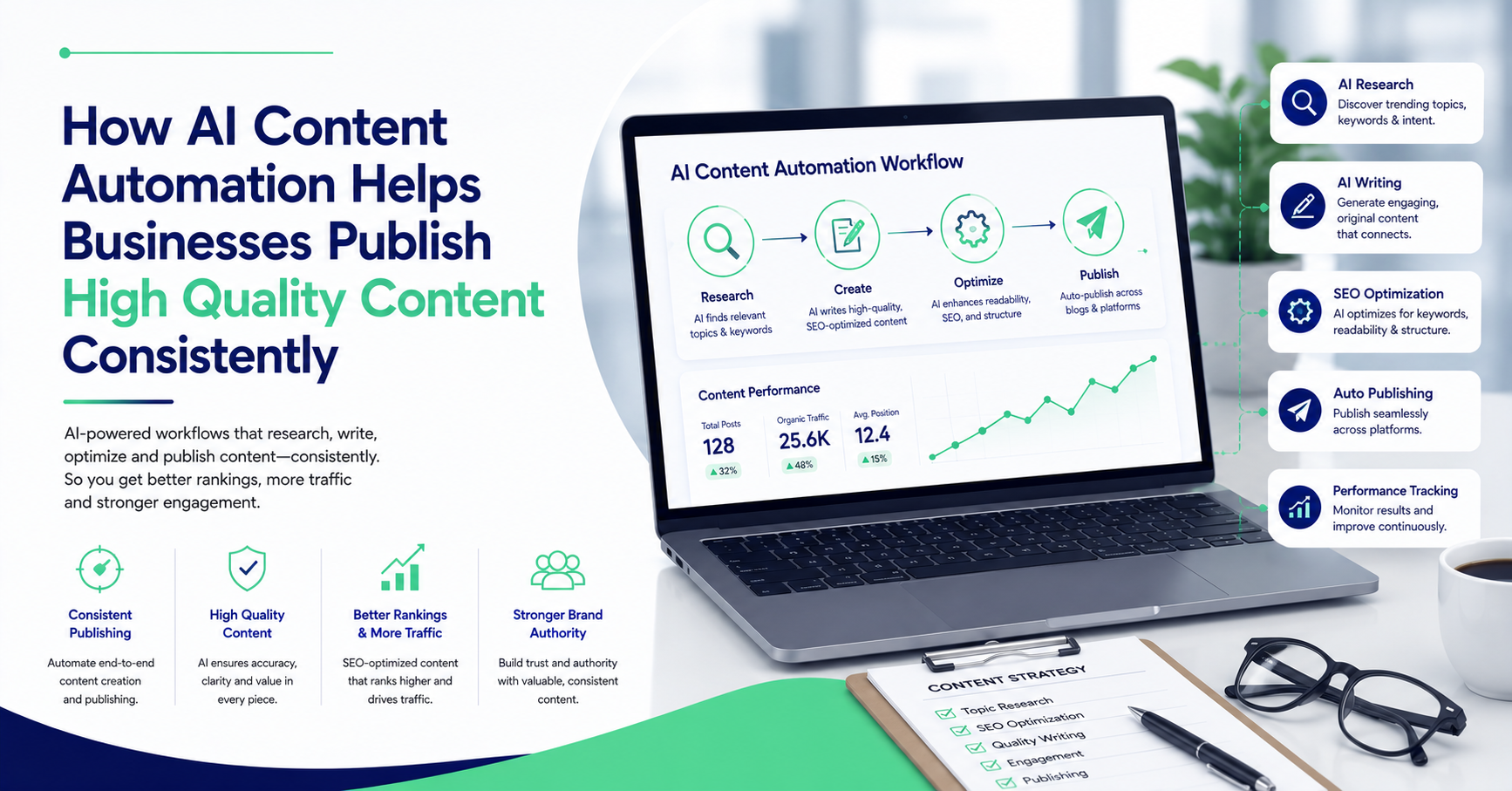
This is precisely why HRL AI was built as one connected system rather than a single writing tool bolted onto a separate publishing calendar. Research, drafting, structure, publishing, and performance tracking are all part of the same workflow, because companies that try to think of them as five separate problems to be solved by five different tools or people end up not publishing anything at all.
Conclusion
The data is genuinely unambiguous: 13x higher odds of positive ROI for consistent publishers, up to 4.5x more traffic for high-frequency businesses, and 30% better return visitor rates for anyone who simply keeps showing up reliably. None of these numbers rewards talent alone. They reward businesses that solved the consistency problem and kept publishing long after the initial motivation naturally faded.
At HRL AI, that's genuinely the gap we exist to close for Indian businesses: not replacing the strategic thinking behind good content, but making sure consistency, the single hardest part of content marketing to sustain manually, finally stops being the reason good businesses quietly disappear from search results.