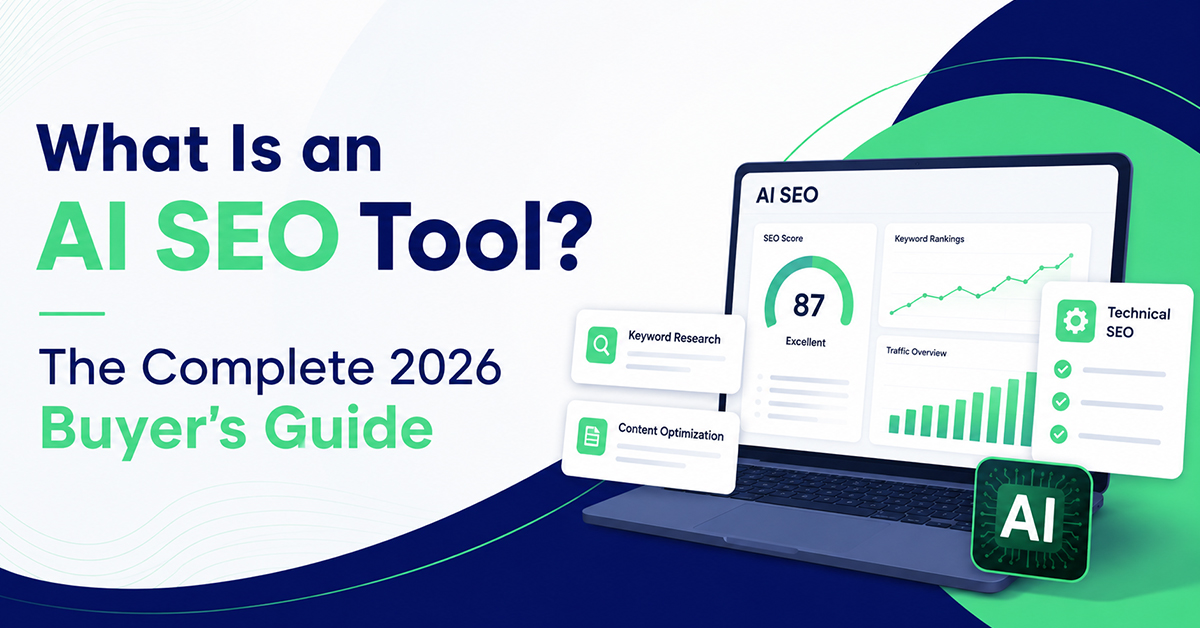
If you've searched for "AI SEO tool" recently, you've probably noticed the same problem everyone else runs into: every result gives you a different definition, and most jump straight into a ranked list of software before actually explaining what the category means. That's a problem if you're a founder, marketer, or SEO consultant trying to decide whether you even need one let alone which one.
This guide skips the listicle format. It explains what an AI SEO tool actually is, how it differs from an AI content generator or a GEO/AEO platform, what it should realistically do for your business, and how to evaluate one without getting pulled in by vendor marketing. Whether you run a D2C brand on Shopify, manage SEO for a growing startup, or advise clients as a consultant, you should be able to read this once and make a confident, informed decision.
What Is an AI SEO Tool, Exactly?
An AI SEO tool is software that uses artificial intelligence typically machine learning and natural language processing to automate or assist with search engine optimization tasks that used to require manual research and analysis. That includes keyword research, content creation and optimization, technical site audits, competitor analysis, and rank tracking.
The "AI" part matters because it changes how the work gets done, not just how fast. A traditional SEO tool might show you a competitor's ranking keywords in a spreadsheet. An AI SEO tool analyzes those keywords, understands search intent behind them, and can generate a content brief or a finished draft that's already structured to compete for that intent.
A Simple Working Definition
If you only remember one sentence from this guide, make it this one: an AI SEO tool is any platform that uses AI to help your website get found and increasingly, get cited across both traditional search engines and AI-powered answer engines like ChatGPT, Perplexity, and Google AI Overviews.
That second half matters more every quarter. In 2026, "search" no longer means only the ten blue links on Google. It includes how often your brand shows up inside an AI-generated answer which is why most modern AI SEO tools now bundle in GEO (Generative Engine Optimization) and AEO (Answer Engine Optimization) capabilities alongside classic SEO features.
AI SEO Tool vs. AI Content Generator vs. GEO Tool — What's the Difference?
This is the part most guides skip, and it's the reason buyers get confused. These three categories overlap heavily, but they aren't the same thing.
Category | Core job | Example use case |
|---|---|---|
AI SEO tool | Full-stack SEO support keyword research, technical audits, content strategy, rank tracking, often with AI writing built in | Planning and running your overall organic search strategy |
AI content generator / AI SEO writer | Focused specifically on producing SEO-structured written content (blogs, product pages, landing pages) | Publishing a consistent volume of optimized blog content |
GEO/AEO platform | Focused specifically on measuring and improving how your brand appears inside AI-generated answers | Tracking and improving citations in ChatGPT, Gemini, or AI Overviews |
SEO automation software | Automates repetitive execution tasks, meta tags, schema markup, internal linking, technical fixes at scale | Fixing thousands of pages without manual work |
Many products, including comprehensive AI SEO platforms, combine two or more of these functions into one subscription. When you're comparing tools, the fastest way to avoid confusion is to ask: which of these four jobs does this specific tool actually do and which does it just claim to touch on?
What Does an AI SEO Tool Actually Do?
Strip away the marketing language, and most AI SEO tools handle some combination of the following five jobs.
Keyword and Topic Research
AI models can process search volume, competition, and intent signals far faster than manual research, surfacing keyword opportunities including long-tail and question-based queries that a human researcher might miss or take hours to find.
Content Creation and Optimization
This is where "AI SEO writer" and "AI content generator" tools live. They generate drafts structured around what's already ranking, then optimize headings, keyword placement, and readability. The output quality varies enormously between tools this is the single most important thing to test before buying (more on that below).
Technical SEO and Site Health
Some AI SEO tools scan your site for indexing issues, broken links, slow-loading pages, and schema errors, then either flag them for a developer or apply fixes automatically.
Rank Tracking and Reporting
AI-assisted tracking goes beyond position numbers, it can flag why a ranking dropped (a competitor refreshed their content, a Google update rolled out, a technical issue appeared) instead of just reporting the change.
AI Search Visibility (GEO/AEO)
The newest category of feature: tracking whether your brand gets mentioned or cited inside AI-generated answers, and structuring content direct answers, clear definitions, well-organized lists to improve the odds that it does.
Why AI SEO Tools Matter More in 2026
Two shifts explain why this category has grown so quickly. First, the sheer volume of content needed to compete has grown a business publishing one blog a month is now competing against sites publishing dozens, and manual production simply can't keep pace for most small teams. Second, search itself has split. A meaningful share of research and product-discovery queries now happen inside AI chat interfaces rather than a traditional search box, and being invisible there is a genuine, measurable business risk that didn't exist a few years ago.
Neither shift means traditional SEO is obsolete. Strong technical foundations, genuine expertise, and helpful content still matter arguably more, since low-effort AI content is easier than ever to spot and easier than ever for Google to demote. What's changed is that doing this well manually, at the pace the market now requires, is no longer realistic for most small and mid-sized teams.
How to Evaluate an AI SEO Tool: A Practical Checklist
Instead of trusting a ranked list, run any tool you're considering through this checklist yourself:
Does it explain search intent, not just keywords? A tool that hands you a keyword list without intent context will lead to content that technically targets a term but doesn't actually answer what the searcher wants.
Can you see and edit the AI's reasoning, not just the output? Look for content briefs, competitor gap analysis, or outlines you can review before a full draft gets generated.
Does it cover both classic SEO and AI-search visibility? In 2026, a tool that only tracks Google blue-link rankings is already behind.
What does the output actually read like? Generate a sample article on a topic you know well. If it sounds generic, vague, or padded, that's exactly how it will read to your customers and to Google's quality systems.
Does pricing match your actual publishing volume? A tool priced for enterprise teams publishing 100+ pages a month is often the wrong fit and the wrong cost for a founder who needs 15–30 solid articles monthly.
Is there a real human editing layer available? The strongest results come from AI-assisted drafts with human review, not fully unattended publishing.
Is AI-Generated SEO Content Safe? What Google Actually Says
This is the question most buyers actually want answered, and most competitor guides underplay it. Google's public guidance is consistent: it does not penalize content simply because it was created with AI assistance. It penalizes content that is unhelpful, low-effort, or produced primarily to manipulate rankings, regardless of whether a human or a machine wrote it.
In practice, that means the risk isn't "using an AI SEO tool." The risk is using one to mass-publish thin, unedited, generic content with no original insight, examples, or expertise behind it. A well-configured AI SEO tool used with editorial review adding real examples, accurate specifics, and a genuine point of view is a legitimate, widely used approach. One used to auto-publish unedited volume at scale is where businesses run into trouble.
AI SEO Tools for Shopify, D2C, and Ecommerce Brands
Ecommerce SEO has a distinct challenge: hundreds or thousands of product pages that all need unique, optimized descriptions, category content, and buying guides a scale that manual writing genuinely cannot sustain.
For Shopify and D2C brands specifically, the best AI SEO tools for Shopify websites and the best AI SEO tool for fashion & D2C brands tend to share a few traits: native integration with your storefront (so content publishes directly rather than through manual copy-paste), support for both product-level SEO and top-of-funnel blog content, and increasingly, visibility tracking for AI shopping assistants, since a growing share of product research now happens inside conversational AI tools rather than a traditional search bar. If you're evaluating options for a D2C or ecommerce brand, prioritize tools that treat blog content, category pages, and product descriptions as one connected strategy rather than three separate tools bolted together.
How Much Does an AI SEO Tool Cost?
Most established AI SEO platforms sit in the $49–$500 per month range internationally, with enterprise plans running higher. For Indian businesses and lean D2C teams, that pricing often doesn't map to actual budget reality which is part of why SEO automation software with India-specific pricing (commonly starting well under ₹2,000/month for a defined volume of optimized content) has become a practical middle ground between an expensive agency retainer and a fully DIY approach.
Whatever budget tier you're in, evaluate cost against three things: the volume of content you actually need each month, whether technical SEO and rank tracking are included or sold separately, and whether the price includes any human strategy support or purely self-serve software.
How an AI SEO Tool Fits Into a Real Content Workflow
Rather than thinking about an AI SEO tool as a single feature, it helps to picture the full loop it should support:
Discover — the tool identifies a keyword or topic opportunity based on your niche, competitors, and search trends.
Brief — it builds a structured outline based on search intent and what's already ranking.
Draft — it generates a first draft with proper headings, meta structure, and internal linking suggestions.
Review — a human editor checks accuracy, adds specific examples or data, and adjusts tone.
Publish — the content goes live directly on your CMS (WordPress, Shopify, Webflow, etc.).
Track and refresh — the tool monitors rankings and traffic, and flags older content that needs updating.
A tool that only handles steps 1–3 is a content generator, not a full AI SEO tool. If your goal is consistent organic growth rather than just faster drafts, make sure whatever you choose covers the full loop — or integrates cleanly with something that does.
Common Mistakes Businesses Make With AI SEO Tools
Publishing without editorial review, treating the AI draft as final rather than a strong starting point.
Ignoring technical SEO while focusing entirely on content volume, indexing and site health issues can quietly cap your results regardless of how good the writing is.
Choosing a tool based on price alone, without testing actual output quality on your own topics first.
Expecting instant rankings. Google typically indexes new content within days, but meaningful ranking movement for competitive terms still takes weeks to months, AI-assisted or not.
Treating classic SEO and AI-search visibility as separate projects, rather than one connected strategy.
Final Thoughts: Choosing the Right AI SEO Tool for Your Business
The right AI SEO tool isn't the one with the longest feature list. it's the one that matches your actual publishing volume, your budget, and your willingness to add a human review layer before content goes live. Start by defining what you actually need: a writer, a full SEO strategy platform, a GEO/AEO tracker, or some combination. Then test real output on a topic you know well before committing.
If you're looking for an AI content generator and AI SEO tool built specifically for consistent, hands-off blog publishing with proper SEO structure including keyword research, meta tags, and internal linking handled automatically HRL Infotechs AI's platform is built around exactly that workflow. For businesses that specifically want a done-for-you monthly blog pipeline rather than a self-serve editor, the AI Blog Agent publishes SEO-optimized posts directly to your site every month, with keyword research and formatting handled end-to-end.