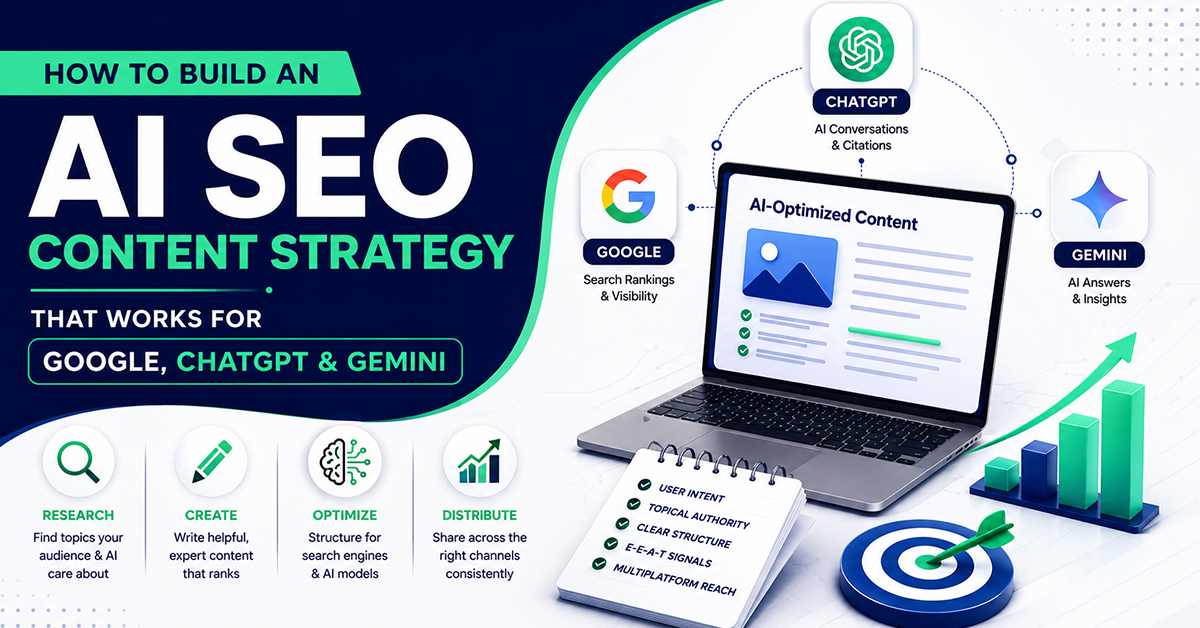
A SaaS company can publish 20 AI-generated articles in a month and still lose visibility to a competitor publishing five genuinely useful ones. The difference is rarely writing speed. It is the strategy behind the content: which questions you target, how topics connect, whether claims are trustworthy, and whether the content gives Google, ChatGPT and Gemini something genuinely useful to understand and reference.
An effective AI SEO content strategy combines traditional SEO with Answer Engine Optimization (AEO) and Generative Engine Optimization (GEO).You start with real search intent, build topical authority, create people-first content with clear answers and evidence, strengthen internal links and entity signals, then use AI SEO tools and automation to scale the repeatable work.
What is an AI SEO content strategy?
An AI SEO content strategy is a structured process for researching, creating, optimizing and measuring content across traditional search engines and AI-powered search experiences. It combines SEO, AEO and GEO instead of treating them as separate campaigns.
The practical shift is simple: you're no longer asking only, "What keyword should this page rank for?" You're also asking, "What question is the customer trying to answer, and does this page provide the clearest, most trustworthy answer?"
A practical AI SEO strategy has five stages:
Research search intent and valuable topics.
Build connected topic clusters.
Create useful, evidence-backed content.
Optimize content for search and AI discovery.
Measure rankings, visibility, citations and conversions.
Google's guidance is clear that AI Overviews and AI Mode do not require special AI-only SEO requirements. Core SEO practices such as crawlability, indexability, internal links and helpful content still matter.
How do you build an AI SEO content strategy step by step?
Start with customer questions that can influence traffic, leads or revenue. Then turn those questions into connected content clusters instead of generating unrelated articles around whatever keywords an AI tool suggests.
1. Start with customer problems, not AI-generated topics
Suppose you're targeting Indian ecommerce businesses. "AI SEO tool" could be a primary keyword, but the real search journey may include questions such as:
What is the best AI SEO tool for an ecommerce business?
How does AI SEO differ from traditional SEO?
Can SEO automation software publish content automatically?
How can I optimize content for ChatGPT and Gemini?
Should I use an AI Content Generator for SEO blogs?
These queries represent different levels of intent. Someone searching "what is AI SEO?" is learning. Someone searching "best AI SEO tool for ecommerce" is evaluating solutions.
That distinction matters. One of the most common mistakes in AI-assisted SEO is creating informational content around commercially valuable queries and then expecting that traffic to convert.
2. Build topic clusters instead of isolated articles
A topic cluster is a group of related pages that collectively cover a subject from different search-intent angles.
For an AI SEO website, the structure could look like:
AI SEO → AI search optimization → GEO → AEO → AI content → SEO automation → AI visibility
Your supporting articles should link naturally to the relevant service or product page. This gives readers a clear next step and helps search engines understand how your pages relate to one another.
HRL Infotechs AI already publishes content around this broader search ecosystem. Its article on AI Search Optimization and visibility beyond Google rankings is a natural supporting resource for this topic.
The important trade-off is depth versus volume. Publishing 50 pages around nearly identical keywords can create a larger site without creating greater authority. Five genuinely differentiated pages can sometimes give you a stronger foundation.
What should AI SEO content look like for ChatGPT and Gemini?
AI-friendly content should make the answer easy to identify, verify and understand. Clear headings, direct answers, relevant entities, useful examples, factual accuracy and strong internal linking matter more than repeating an exact keyword throughout the page.
3. Answer the question early
Don't make readers search through 700 words to find a two-sentence answer.
For each important section, provide the direct answer first and then add the explanation.
For example:
What is GEO?
Generative Engine Optimization, or GEO, is the practice of improving the likelihood that a brand's content is discovered, understood and potentially referenced in generative AI experiences.
Then explain how GEO relates to SEO, what content characteristics support discoverability and where the limitations are.
This structure works well for users because they can quickly understand the answer. It also gives retrieval systems clearly defined information rather than forcing them to infer the main point from a long paragraph.
4. Add information competitors cannot easily copy
This is where E-E-A-T becomes practical.
Google's guidance for AI search emphasizes unique, valuable, people-first content rather than mass-produced pages created primarily to manipulate rankings.
If ten websites define "AI SEO" in almost identical language, rewriting the definition won't create much competitive advantage.
Add information such as:
First-hand observations from client work
Original examples
Screenshots or proprietary data where appropriate
Tested workflows
Expert commentary
Specific implementation decisions
Properly attributed statistics
Clear limitations and trade-offs
A useful rule is: AI can accelerate the first draft, but human experience should determine what makes the final content worth trusting.
HRL Infotechs AI's recent article on using an AI Content Generator without losing Google rankings or E-E-A-T signals covers the same principle from the content-production side.
How do SEO, AEO and GEO work together?
SEO provides the foundation for organic visibility. AEO focuses on providing direct answers, while GEO focuses on making information useful and understandable within generative search experiences. The three should support one content strategy rather than become three separate publishing programs.
SEO: Build the foundation
SEO covers crawlability, indexing, search intent, internal linking, technical health, content relevance and user experience.
Without these fundamentals, adding GEO terminology to your content won't solve the underlying problem.
AEO: Make answers clear
Answer Engine Optimization focuses on questions and direct answers. Definitions, concise explanations, FAQs and descriptive headings make important information easier to identify.
GEO: Build citation potential
Generative Engine Optimization focuses on making content authoritative, specific, contextual and useful enough for generative systems to potentially retrieve or reference.
The distinction matters, but don't build three separate content calendars. One well-researched page can rank organically, answer a question and contribute useful source material to AI-generated responses.
HRL Infotechs AI's existing analysis of SEO vs GEO in 2026 provides additional context on how the two approaches overlap.
Which AI SEO tools should you use?
Choose an AI SEO tool according to the work it improves, not the number of AI features listed on its pricing page. The useful tools are the ones that reduce repetitive research, writing, optimization, tracking or publishing work while leaving strategic decisions under human control.
A practical workflow looks like this:
Research → Keyword mapping → Topic clustering → Content brief → AI-assisted writing → Human review → Optimization → Internal linking → Publishing → Measurement
HRL Infotechs AI's platform is built around this type of workflow. Its Content Engine is positioned for SEO-optimised blogs, articles and landing pages, while its Keyword Tracker is designed to monitor rankings, identify lower-competition opportunities and track competitor movement.
For larger publishing operations, its Automation Engine is positioned around trigger-based workflows, scheduling and bulk content processes.
The judgement call here is important: automate execution, not accountability. An AI Content Generator can create a draft quickly, but your team should still verify claims, examples, sources and business relevance before publication.
How should you measure AI SEO performance?
Don't measure an AI SEO content strategy only by how many articles you publish. Measure whether the content is generating relevant visibility and contributing to business outcomes.
Track traditional SEO metrics such as:
Organic impressions
Organic clicks
Keyword positions
Indexed pages
Engagement
Leads
Conversions
Then add AI-search observations where reliable measurement is available:
Brand mentions in relevant AI responses
Competitor mentions
Referenced or cited pages
Visibility across priority customer questions
AI-assisted referral traffic
Conversions influenced by organic or AI discovery
There is one important limitation: ChatGPT and Gemini don't provide a universal ranking position equivalent to Google's traditional keyword position. Responses can vary according to the query, model, context, location and time.
So don't promise clients an "AI ranking." Monitor visibility across a defined set of important customer questions instead.
HRL Infotechs AI also discusses this broader measurement model in its article on AI citations and their impact on SEO, GEO and AEO.
What should you do in the next 30 days?
Don't rebuild your entire SEO program at once. Start with the pages and questions closest to business value.
Week 1: Find the gaps
Audit your existing rankings, important service pages, competitors and the questions customers ask across Google, ChatGPT and Gemini.
Look for pages ranking on positions 8 to 30. Improving an existing relevant page can be more efficient than creating another article targeting a similar keyword.
Week 2: Build your content map
Select 3 to 5 core topics and map supporting questions around each one.
Give every topic:
A primary search intent
A target audience
A business objective
A primary keyword
Supporting questions
A relevant internal-link destination
Week 3: Create and optimize
Publish content that answers questions directly, demonstrates expertise and adds information competitors don't have.
Use an AI Content Writing Tool to accelerate research and drafting, but review important factual claims and ensure the final article contains genuine value.
Week 4: Measure and refine
Check Search Console, rankings, conversions and AI visibility observations.
Improve pages that receive impressions but weak clicks. Expand topics where competitors repeatedly appear and your brand does not.
This is where many AI SEO programs fail. Publishing isn't the finish line. Your performance data should determine what you update, expand, consolidate or stop producing.
Can SEO automation replace an SEO strategist?
No. SEO automation software can remove repetitive work, but it cannot replace strategic judgement, subject expertise or responsibility for business outcomes.
The strongest setup is human-led strategy supported by automation. AI can accelerate keyword discovery, content briefs, drafting, optimization, internal linking and publishing. Your team should decide which topics matter, whether claims are accurate and whether the finished content genuinely deserves to represent the brand.
This becomes particularly important when targeting both India and the USA. Search terminology, commercial intent, competition and customer expectations can differ between the two markets even when the core topic is identical.
Build your AI SEO content system before scaling it
If your current process is simply "find a keyword, ask AI to write an article and publish it," you're missing most of the opportunity.
A stronger AI SEO content strategy connects search intent, topical authority, E-E-A-T, internal linking, SEO, AEO, GEO and measurement into one repeatable system.
Use AI to increase production capacity. Use human expertise to decide what deserves to be published.
If your team is spending more time managing keyword research, content production, optimization and publishing than actually improving the strategy, HRL Infotechs AI can help bring those workflows into one system. Its platform combines content creation, keyword intelligence, automation and analytics rather than treating each task as a separate process.