A marketing team starts using an AI content generator because publishing four articles a month is no longer enough to compete. Within days, they can create outlines, drafts, titles, and meta descriptions much faster. Then the problems start showing up. Several articles sound alike, some claims need verification, and the pages offer little that a reader couldn't find elsewhere.
Using AI is not the problem. The risk comes from publishing AI-generated content without adding real experience, expertise, original information, and editorial judgement. You can use an AI content generator to increase content production while protecting Google rankings and E-E-A-T, but the generated draft should be treated as a starting point, not the finished article.
Does Google penalize AI-generated content?
Google does not automatically penalize content because AI was used to create it. Google's focus is whether the finished content is helpful, reliable, original, and created for people rather than primarily to manipulate search rankings.
This distinction matters because generative AI makes it possible to create hundreds of pages very quickly. More pages do not automatically mean more organic traffic. If those pages repeat existing information or provide little value, publishing at greater volume can simply create more content that needs fixing later.
The better question is not "Was AI used?" Ask instead: "Does this page give the reader a useful reason to choose it over the other results?"
How should you use an AI content generator for SEO?
Use an AI content generator for research, outlining, drafting, optimization, and repetitive production tasks. Keep topic selection, search intent, fact verification, original insights, and final publishing decisions under human control.
Before generating an article, establish the audience, search intent, primary keyword, related terms, questions to answer, competing pages, unique information you can contribute, relevant internal pages, and the business goal.
This prevents a common AI content problem: producing a polished article that technically covers a topic but gives readers no new reason to stay on the page.
HRL Infotechs AI's Content Engine is designed to generate SEO-optimized blogs, articles, and landing pages using AI trained around what actually ranks. The website also highlights competitor gap analysis, SEO-optimized structure, and source-backed content as part of its content capabilities.
Give the AI a specific brief
"Write a 1,500-word article about AI SEO" is too broad. It gives the model little direction and usually results in predictable content.
A stronger brief would identify the reader and the problem:
Explain how businesses in India and the USA can use AI-generated content to increase publishing capacity while protecting search visibility, originality, and E-E-A-T.
Now the AI has a defined audience, purpose, and editorial direction.
Can AI-generated content still rank on Google?
Yes. AI-assisted content can rank when the finished page satisfies search intent and provides useful, trustworthy information. AI usage itself does not determine whether a page deserves to rank.
A strong page should answer the main question quickly, explain the subject accurately, demonstrate relevant knowledge, use credible sources, and provide information that goes beyond a rewritten version of another website.
This is where AI SEO content needs to be more than keyword placement. The content needs to reflect actual search demand and provide meaningful information.
HRL Infotechs AI's recent article on AI content writing tools and Google AI Overviews also emphasizes the shift from simply ranking pages toward creating content that can be understood and potentially referenced by AI search systems.
The practical lesson is simple: use AI to increase production capacity, but don't confuse production volume with search value.
What is E-E-A-T and why does it matter for AI content?
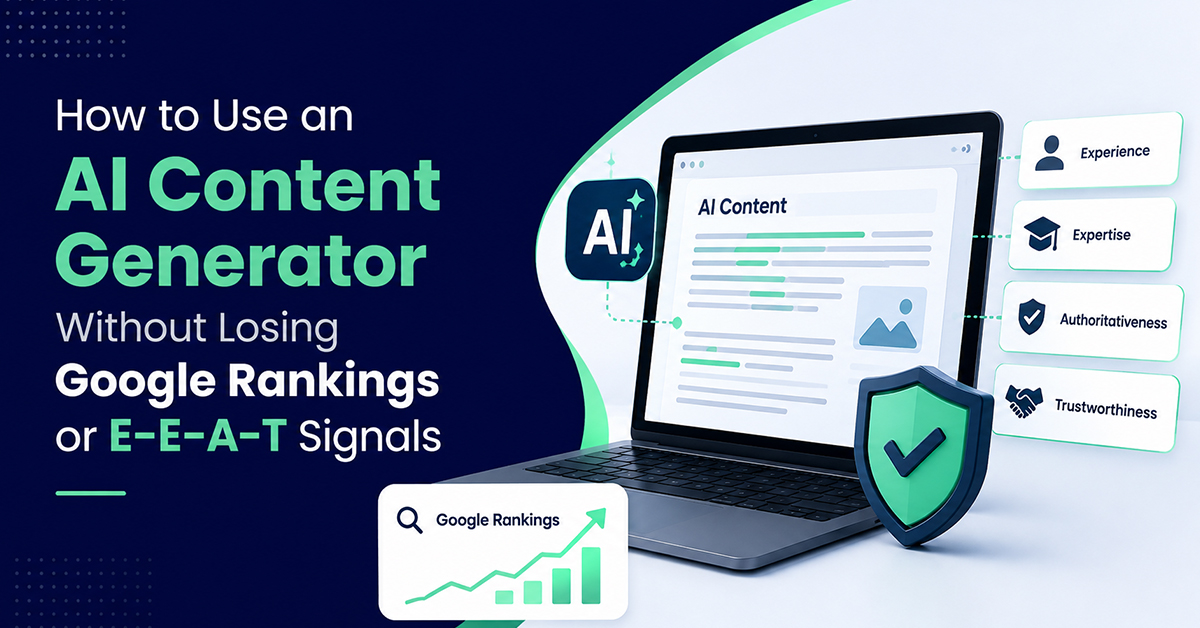
E-E-A-T stands for Experience, Expertise, Authoritativeness, and Trustworthiness. Google uses these concepts to evaluate qualities associated with high-quality content, although E-E-A-T itself is not a single ranking factor.
AI can help communicate information, but it cannot genuinely create first-hand experience. That needs to come from your business, your subject-matter experts, original research, or properly attributed sources.
How do you add experience to AI-generated content?
Add information that comes from actually doing the work.
Suppose an ecommerce team uses AI to create descriptions for 500 products. AI can identify product attributes and produce consistent copy. It may not know which questions customers repeatedly ask before purchasing.
The marketing team does.
If customers repeatedly ask whether a product is suitable for a particular use, that question can become useful content. If one product feature repeatedly influences purchasing decisions, explain why it matters.
Those details demonstrate experience because they come from real customer interactions and business knowledge.
Do not create fictional case studies, invented customer experiences, or made-up results simply to make AI-generated content appear authoritative.
How can AI content demonstrate expertise?
Expertise is demonstrated through accurate reasoning and sound decisions, not by filling an article with technical terminology.
For example, an AI tool might identify 30 keywords around one subject. An experienced SEO professional may decide that only 12 deserve individual pages because the remaining terms have almost identical search intent.
That decision can prevent unnecessary duplication and keyword cannibalization.
AI can identify opportunities. Expertise determines which opportunities are worth pursuing.
How do authoritative sources improve AI content?
Use primary sources whenever possible.
For Google Search topics, use Google's own documentation. For regulations, use the relevant government or regulatory source. For research claims, go back to the original study rather than relying on a third-party summary.
This matters because AI systems can generate confident statements that sound credible without being supported by evidence.
Why is trust important for AI-generated content?
Trust depends heavily on accuracy and transparency.
Before publishing AI-generated content, verify statistics, dates, pricing, technical specifications, regulations, quotes, product claims, and other information that could influence a reader's decision.
If a number is illustrative, identify it as illustrative.
If you cannot verify a claim, don't present it as established fact.
What AI content mistakes can hurt Google rankings?
The biggest SEO problems usually come from how AI is used rather than from AI itself.
Publishing too many similar pages
AI makes it easy to create pages for every variation of a keyword.
That doesn't mean every variation deserves its own URL.
If several keywords have almost identical search intent, one comprehensive article can be more useful than multiple short pages repeating the same information.
Quality should determine publishing volume.
Rewriting competitors without adding value
Competitor analysis is useful because it shows what information Google currently considers relevant.
The problem begins when you copy those topics, give the structure to AI, and publish a rewritten version.
The wording may be different, but the information can remain almost identical.
Instead, identify what is missing.
Add original examples, practical experience, new research, better explanations, expert opinions, updated information, or useful limitations.
If your article says essentially the same thing as the top-ranking pages, changing the wording isn't enough.
Overusing exact-match keywords
An AI SEO content generator can interpret your keyword list too literally.
If your primary keyword is "AI content generator," you don't need to repeat that exact phrase in every heading.
Use related language naturally, including AI content generation, AI writing tools, AI SEO content, content optimization, AI-assisted writing, and SEO content creation.
The objective is topical relevance, not keyword repetition.
Publishing without human review
A human review should be more than a grammar check.
The reviewer should verify facts, evaluate originality, check search intent, confirm internal links, assess examples, and decide whether the article genuinely deserves publication.
HRL Infotechs AI's AI Content Quality Test highlights several practical warning signs, including repetitive sections, generic introductions, and content that lacks meaningful human judgement.
That is a useful distinction: making AI writing sound human is not the same as making it valuable.
How can you optimize AI content for Google and AI search?
Make your content easy for readers and search systems to understand. Answer important questions directly, use descriptive headings, explain key terms clearly, support factual claims, connect relevant pages, and demonstrate genuine subject knowledge.
AI-powered search makes specificity even more useful. A person may ask ChatGPT, Gemini, Perplexity, or Google a detailed question instead of entering a short keyword.
Your content should therefore answer complete questions rather than simply repeat target phrases.
HRL Infotechs AI's AI Search Optimization guidance explains that modern visibility extends beyond traditional rankings and includes making content understandable and useful for AI-powered search experiences.
This does not mean abandoning traditional SEO. Crawlability, indexing, relevant content, internal links, technical health, and search intent remain important.
How can an AI SEO Tool support content optimization?
An AI SEO Tool can help identify keyword opportunities, competitor patterns, ranking gaps, and topics worth targeting before you start writing.
This can prevent another common mistake: creating articles around keywords that have search volume but little relevance to your actual audience.
HRL Infotechs AI's Keyword Tracker is designed to track rankings, identify low-competition opportunities, and monitor competitor movement. The website states that it can also track SERP features and provide keyword opportunities based on existing content, competitors, and search trends.
This information can help you answer an important question: should you create a new article or improve an existing page?
For example, if an existing page ranks at position 11 for an important keyword, improving that page may be more valuable than publishing another article targeting a closely related phrase.
How can AI Content Automation support SEO?
AI Content Automation can reduce repetitive tasks such as content creation, scheduling, bulk imports, and publishing. It becomes useful when automation is combined with quality controls rather than being used to publish everything without review.
HRL Infotechs AI's platform includes an Automation Engine for scheduled content, bulk content imports, automated publishing, and recurring content actions.
The important trade-off is volume versus editorial control.
Publishing 30 weak articles may look impressive in a monthly report. Publishing 10 strong articles with better research, original information, and useful internal links can create more lasting SEO value.
Automate repetitive actions. Keep quality decisions with people.
Can an AI Blog Agent replace an SEO content writer?
An AI Blog Agent can handle significant parts of content production, but it shouldn't replace SEO strategy or subject expertise.
AI can assist with keyword research, article creation, SEO metadata, internal links, and publishing. A skilled SEO professional still needs to determine whether the topic is valuable, whether the information is accurate, whether the article overlaps with existing pages, and whether the final result is genuinely useful.
HRL Infotechs AI's AI Blog Agent is designed to handle keyword research, SEO-optimized blog creation, metadata, internal links, and publishing directly to a connected website.
The key point is that automation can remove repetitive production work, but it shouldn't remove editorial accountability.
What should you check before publishing AI-generated content?
Use a final quality review that focuses on substance rather than simply looking for phrases that sound machine-written.
Ask:
Does the article answer the searcher's actual question?
Is the information accurate?
Are important claims supported?
Does the article contain original information?
Are the examples realistic and specific?
Does it demonstrate relevant experience?
Are internal links genuinely useful?
Does the article support the site's wider topical coverage?
Is the primary keyword used naturally?
Would you trust the page enough to make a decision based on it?
If several answers are no, don't publish yet.
Also avoid sending the article back to AI with the instruction "make it more human." That often changes the wording without fixing the actual weakness.
If the article lacks evidence, add evidence.
If it lacks experience, add genuine experience.
If it lacks useful examples, add specific examples.
What should you do with existing AI-generated content?
Don't delete an article simply because AI helped create it.
Start by reviewing pages based on quality and performance.
Look for articles with declining impressions, weak rankings, overlapping search intent, outdated information, unsupported claims, poor internal linking, or little original value.
Then decide whether each page should be improved, consolidated, updated, redirected, rewritten, or removed.
Sometimes the strongest SEO improvement isn't another article. It is combining several weak pages into one stronger resource and improving the internal connections around it.
How can businesses scale AI-generated content safely?
Start with a small group of strategically important topics and establish your quality standard before increasing production.
Use AI for research, content creation, keyword analysis, optimization, and repetitive publishing tasks. Keep humans responsible for original insights, factual verification, search intent, and final approval.
HRL Infotechs AI brings content creation, keyword tracking, SEO intelligence, and automation together. Its Content Engine handles SEO-focused content creation, while Keyword Tracker helps monitor rankings and opportunities. The platform also includes guest blogging and social media tools for businesses that want to extend content distribution.
The benefit isn't simply creating more words. It is reducing repetitive work so your team can spend more time on strategy, accuracy, and content that actually differentiates your brand.
The right way to use AI without losing Google rankings
AI content generation can make research and content production considerably faster. But speed alone doesn't create rankings.
Use an AI content generator to accelerate drafting. Use an AI content writing tool to support content production. Use an AI SEO Tool to identify search opportunities and monitor performance. Use AI content automation to reduce repetitive publishing work.
Then add the elements AI cannot genuinely manufacture: first-hand experience, expert judgement, original information, accurate research, and accountability.
If your business needs to create more SEO content while maintaining quality, HRL Infotechs AI's Content Engine and AI Blog Agent provide tools for businesses that want to reduce the manual effort involved in research, writing, optimization, and publishing.
The goal isn't to publish everything AI can generate.
The goal is to use AI to help your team publish content that is more useful, more relevant, better researched, and more trustworthy.