Every week, I have serious conversations with the marketing leaders, and there is a common issue they are facing: "We started using AI for the efficient frequency, but as of now our traffic is drastically dropping, and engagement is flat". That is not just a coincidence.
Businesses across every industry have embraced AI-generated content to scale their publishing. And honestly, it makes sense: a first draft in minutes instead of hours is a real productivity win. But somewhere between the tool and the publish button, a critical step is getting skipped: making the content actually worth reading. Speed is not the problem. Skipping judgment is. After reviewing hundreds of AI-assisted blog posts, the same issues keep appearing.
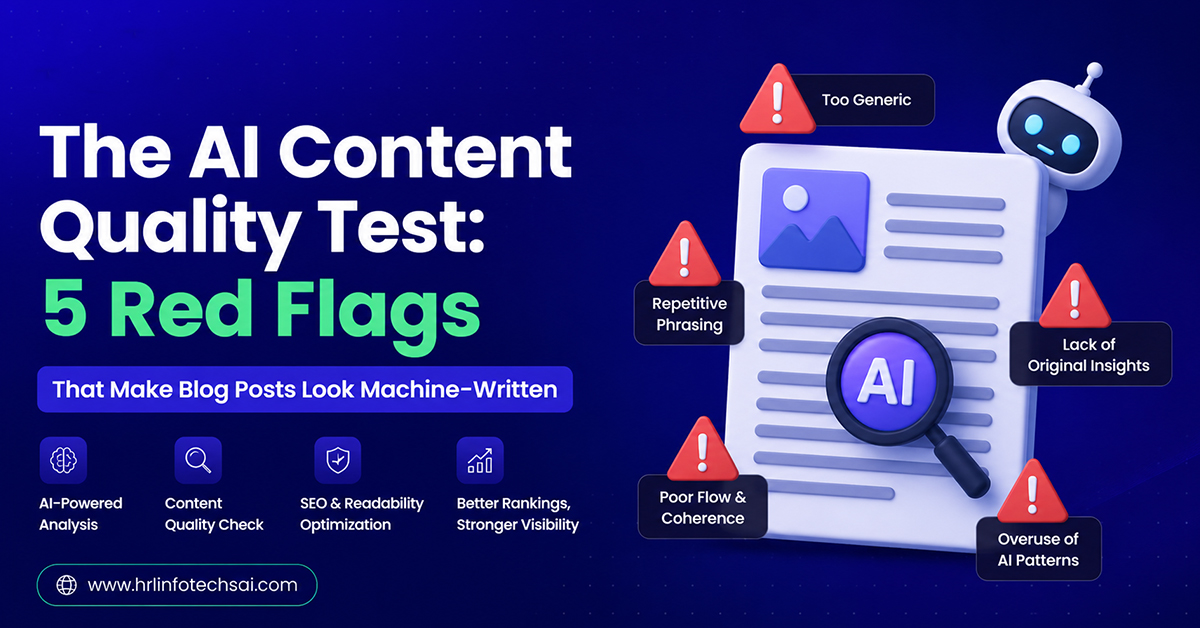
Watch out for these five signs your content might be generated by a machine - plus how to fix every single one before sharing it online.
Red Flag 1: The Content Could Have Been Written in 2019
One of the clearest signs of low-quality AI-generated content is that it feels disconnected from current market conditions. It presents as a Wikipedia summary with added bullet points.
A while back, I looked at a blog post - supposedly showing expert insight - for a software service. It tried explaining cloud storage with: “Cloud technology allows businesses to store data remotely.” The readers? IT managers checking out big-company tools. This group has known that fact for at least ten years. Not helpful now.
AI blog-writing tools draw on patterns from billions of existing pages. If you feed them a generic prompt, they produce generic output, which is a repackaged version of what already exists online.
How to fix it:
Ask one question before you write the brief: what does our audience believe right now that is slightly wrong? Challenge that assumption in the post. Add a recent observation, a client pattern you have noticed, or a contrarian take on common practice. Something that could only have been written this year, by someone who actually works in this space.
Red Flag 2: Every Section Follows the Exact Same Beat
Read the post aloud. If every paragraph has the same rhythm three sentences, one bullet list, a filler transition you are looking at structural repetition that quietly signals machine authorship.
Human writers get impatient with themselves. They cut paragraphs, use a two-word sentence for emphasis. They ask a question, then immediately answer it. They contradict something they said two paragraphs earlier and explain why.
AI blog writing tools default to balance and consistency. But balance is not the same as engaging.
How to fix it:
After generating a draft, deliberately break the structure at least twice. Add a one-sentence paragraph. Open a section mid-thought. Small interruptions in rhythm make prose feel written by a person rather than produced by a process.
Red Flag 3: There Is No Author Behind the Words
The red flag most of the brands underestimate. To humanise AI content, you do not always have to rewrite or improvise every line. You only have to add a perspective of a specialist who has actually worked in this field.
AI knows facts. It does not know what it feels like to make the wrong call at 6 pm on a Friday. It cannot describe the moment a client realised their strategy was broken three months too late. That gap is exactly where trust is built or lost.
How to fix it:
After the AI draft is done, add two or three sentences that come from real experience. A common client mistake. Something that surprised you the first time you encountered it. A decision that looks obvious in retrospect but never does in the moment. These additions take five minutes and transform the credibility of the entire piece.
Red Flag 4: The Content Answers a Question Nobody Asked
Effective AI content generation for SEO does not initiate with a topic. It starts with a motive and an intent: who is searching, and what's the problem they are trying to solve?.
A person searching "What is Content Marketing?" might be curious but unaware. Someone searching "Why Our Content Strategy Stopped Working After the Algorithm Update" feels urgency, maybe frustration. One reader lacks knowledge. The other faces pressure at work. Same topic, yet their needs split sharply apart. Tools shaped for beginners miss what experts actually need. Many automated systems still write as if everyone starts from zero. Reality often lands much further along the path.
How to fix it:
Before writing the brief, search the target phrase and read the top five results. Then search the related questions that appear underneath. Start by noticing how search results miss the mark. Your piece lives right there - in the space users find annoying. Shape words around real moments, not imagined ones. Let each paragraph reflect steps people take, instead of pushing them forward. What shows up online often skips the struggle; your job? Fill it without fanfare. Readers arrive with context already. Meet that truth first.
Red Flag 5: The Draft Goes Live Without a Human Edit
The most expensive mistake in AI-powered content marketing is treating the first output as the finished product. Strong AI content optimisation is not about grammar checks. It is about asking harder questions: Does the opening earn attention in the first three lines? Does each section carry its weight, or does it repeat something already said? Does the conclusion land, or does it just stop?
Automated blog writing software is a production accelerator, not an editorial replacement. The businesses seeing real results from AI blogging for business treat editors as strategists people who shape the output into something worth reading, not people who proofread it and move on.
How to fix it:
Build a five-question editing checklist and run every post through it before publishing. Make at least one deliberate human decision per section. That ownership is what separates content that builds trust from content that just fills a calendar.
Conclusion
Red flags listed aren’t failures of AI itself. What trips people up is how companies actually use it. Rewrite the request clearly, bring in genuine human insight, shape each piece with a purpose, make sure answers match what users really ask - suddenly, results shift fast. Attention grows. Visibility climbs.
If you are serious about scaling content without losing the trust you have built with your audience, HRL Infotechs AI is built for exactly that. Their platform combines smart content generation, keyword tracking, and automated publishing into one connected system so every piece you produce is backed by real data, shaped around your brand voice, and optimised to perform from day one.
Not just a writing tool. The infrastructure that makes quality at scale actually achievable.