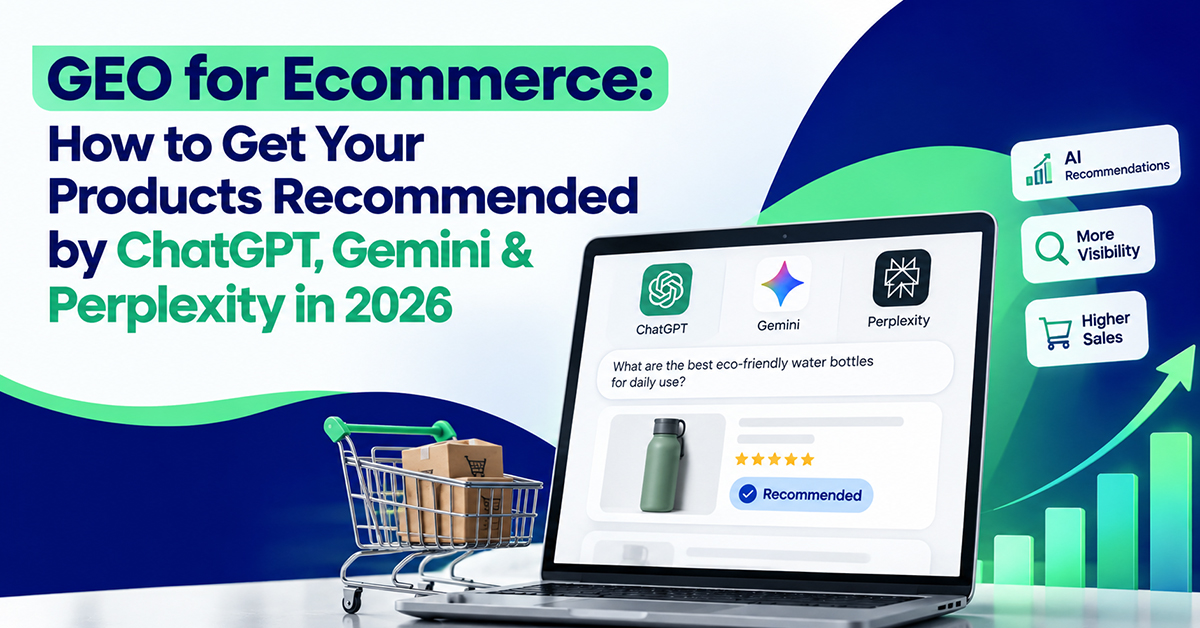
Ecommerce search is changing rapidly. Buyers are no longer relying only on traditional search engines to discover products, compare options, and decide what to purchase. AI-powered platforms such as ChatGPT, Gemini, and Perplexity are becoming part of the product research journey, giving shoppers direct answers instead of requiring them to browse through dozens of search results.
For ecommerce brands, this creates a new visibility challenge. Ranking on Google is still important, but it is no longer the only opportunity to be discovered. Your products also need to be presented in a way that AI systems can understand, retrieve, compare, and reference when answering commercial queries. This is where GEO for ecommerce becomes important.
Generative Engine Optimization, or GEO, focuses on improving how a brand's digital information can be discovered, understood, and potentially referenced across generative search experiences. For ecommerce businesses, that means connecting product data, useful content, technical SEO, reviews, internal links, and credible sources into one clear search strategy.
What Is GEO for Ecommerce?
GEO for ecommerce is the practice of optimizing product and brand information so generative AI systems can better understand, retrieve, and potentially reference it when answering shopping-related questions.
Traditional ecommerce SEO focuses heavily on rankings, organic traffic, product keywords, category pages, and technical performance. GEO adds another layer. It considers how your information may be interpreted when an AI system answers questions such as "Which water-saving bathroom products are suitable for Indian homes?" or "What should I look for when buying an eco-friendly shower?"
The two approaches should not be treated as competing strategies. Strong crawlability, useful content, internal linking, structured information, and clear product pages remain valuable foundations for both traditional search and AI search. Google's documentation also continues to emphasise core SEO practices for its AI-powered search experiences.
Why Is GEO Becoming Important for Ecommerce Brands?
Product discovery is becoming more conversational. Instead of searching only for a product name, customers can describe a problem, budget, location, preference, or combination of requirements and expect an AI system to help narrow the options.
That creates a different type of visibility opportunity. A product can be discovered through a traditional ranking, a shopping result, a comparison article, an AI-generated answer, or a source cited within that answer.
For ecommerce teams, the practical lesson is not to abandon SEO. It is to expand the definition of search visibility.
A useful ecommerce GEO strategy should help your brand:
Answer product-related questions clearly
Explain specifications without ambiguity
Connect products with relevant educational content
Strengthen topical authority
Improve product description quality
Build credible external references
Make important information easy to crawl and understand
Monitor where competitors appear in AI search
The goal is not to guarantee a recommendation. No legitimate GEO strategy can promise that a specific AI platform will recommend a particular product.
How Does GEO vs SEO Differ for Ecommerce?
SEO and GEO overlap, but they focus on different visibility environments.
SEO is primarily concerned with helping pages appear in traditional search results. It involves keyword targeting, technical optimization, internal linking, content quality, authority, and user experience.
GEO focuses on improving the quality and clarity of information available to generative systems that may retrieve and use that information in an AI-generated response.
For example, an ecommerce brand selling sustainable bathroom products might optimize a category page for "eco-friendly bathroom products." That is traditional SEO.
It could then create detailed buying guides explaining water efficiency, installation requirements, material choices, maintenance, and product comparisons. Those resources give both search engines and AI systems more useful context around the brand and its products.
The strongest strategy connects both rather than creating separate SEO and GEO programs.
What Information Should Your Product Pages Include?
Start with the information a customer needs to make a purchase decision.
A strong product page should clearly communicate the product type, materials, dimensions, compatibility, installation requirements, intended use, maintenance instructions, warranty information, availability, and meaningful limitations.
This matters because AI systems cannot reliably fill gaps in your product information. If an important specification is missing, unclear, or presented only inside an image, the system may have less usable information to work with.
For example, a water-saving shower product should not simply claim that it is "eco-friendly." The page should explain what makes it water-efficient, provide available flow information, describe compatibility, and clarify installation requirements.
Specific information is more useful than promotional language.
How Does Product Description Optimization Help AI Search?
Product description optimization is no longer only about inserting keywords into ecommerce listings. It is about making the product understandable to both shoppers and search systems.
Consider two descriptions:
"Premium eco-friendly shower designed for modern homes."
The statement sounds attractive, but it tells the reader very little.
A stronger description could explain the product type, water-flow characteristics, material, installation method, suitable applications, maintenance requirements, and limitations.
That gives the shopper more useful information and creates clearer factual context for search systems.
For large ecommerce catalogs, maintaining this quality across hundreds or thousands of products can be difficult. An AI content generator can help create initial product descriptions, FAQs, category copy, and supporting content at scale. However, specifications should always be checked against the actual product before publication.
AI can speed up production. It should not be allowed to invent product features.
How Can You Get Products Recommended by ChatGPT?
There is no guaranteed formula for getting a product recommended by ChatGPT, Gemini, or Perplexity. AI responses can vary based on the query, available sources, context, location, product information, and changes to the underlying systems.
What ecommerce brands can do is improve the information those systems can discover and understand.
Start with your product pages. Make important facts visible as text, use clear terminology, and avoid vague claims.
Next, create supporting content around genuine buyer questions. A sustainable home-products store could publish guides covering water efficiency, bathroom fixture selection, installation considerations, maintenance, product comparisons, and common buying mistakes.
Then strengthen the wider web presence around your brand. Genuine reviews, relevant industry references, useful comparison content, and credible third-party mentions can give search systems additional context.
Finally, monitor the questions that matter to your business. Instead of asking only whether your website ranks for a keyword, check whether your brand appears when customers ask relevant commercial questions in AI search.
What Are AI Citations for Ecommerce?
AI citations for ecommerce are references or links to websites, product pages, publications, or other sources that support information included in an AI-generated answer.
For an ecommerce brand, being referenced can place the business inside the research process itself.
Suppose a customer asks an AI platform for sustainable bathroom products available in India. The response may include product recommendations, comparisons, explanations, and supporting sources.
If your product page or a useful article from your website is selected as a source, your brand can gain visibility even though the customer did not begin with a conventional Google search.
There is no special schema or shortcut that guarantees an AI citation. The practical approach is to create useful, original, well-structured information and maintain strong technical SEO foundations. Google's guidance also states that there are no additional technical requirements specifically required for inclusion in AI Overviews or AI Mode.
For a deeper explanation, see this guide to AI citations and their impact on SEO, GEO, and AEO.
How Can Competitor Gap Analysis Improve Ecommerce GEO?
A competitor gap analysis can reveal topics and questions your website does not currently answer.
Start by identifying competitors that appear frequently for your important product categories. Review the information they provide across product pages, category pages, buying guides, comparison articles, FAQs, reviews, and supporting resources.
Then look for gaps.
You might discover that competitors explain installation but not maintenance. They may discuss product benefits but provide limited information about compatibility. Or they may have detailed comparison content while your site has only individual product descriptions.
These gaps can become content opportunities.
The important trade-off is quality versus volume. Publishing dozens of articles that repeat the same information will not necessarily create stronger visibility. A smaller set of detailed resources that genuinely answers different customer questions can create a more useful topic cluster.
HRL Infotechs AI's existing content strategy also emphasises competitor analysis, topic clustering, internal linking, and search-intent-driven content rather than simply increasing article volume.
Can an AI SEO Tool Help With Ecommerce GEO?
An AI SEO tool can support many of the repetitive activities involved in an ecommerce GEO strategy.
Depending on the platform, these tasks can include keyword research, competitor analysis, topic discovery, content briefs, content generation, optimization, internal-link suggestions, rank tracking, and performance monitoring.
The important distinction is between automation and strategy.
A tool can identify that competitors are publishing content around a particular question. Your team still needs to decide whether that question is relevant to your products and customers.
A practical workflow looks like this:
Research → Competitor Gap Analysis → Topic Mapping → Content Creation → Human Review → Internal Linking → Publishing → Measurement
HRL Infotechs AI currently positions its platform around AI-powered research, competitor gap analysis, SEO-optimized content, AI citation readiness, keyword tracking, and automated content workflows.
For ecommerce brands considering an AI SEO tool, the useful question is not "How many AI features does it have?" Instead, ask whether it can reduce repetitive work while keeping strategic and editorial decisions under human control.
How Should You Use an AI Content Generator Without Hurting Quality?
An AI SEO content generator can make ecommerce content production faster, but speed should not become the main objective.
Use AI to create initial drafts, expand topic ideas, structure FAQs, generate product-copy variations, and prepare content briefs. Then add the information that makes the page genuinely useful.
That may include product specifications, customer questions, installation experience, expert recommendations, original observations, product limitations, photographs, test results, or properly sourced information.
Google's guidance focuses on helpful, reliable content rather than whether AI was involved in its creation. The risk comes from publishing large amounts of low-value, repetitive content without meaningful review or original value.
For a more detailed workflow, see this guide on using an AI content generator without losing Google rankings and E-E-A-T signals.
Where Does SEO Automation Software Fit Into the Strategy?
Ecommerce GEO is not a one-time optimization project. Product catalogs change, prices change, competitors publish new content, search behaviour changes, and older pages need updates.
That makes SEO automation software useful for repetitive processes.
Automation can help with keyword monitoring, content planning, publishing schedules, internal-link workflows, content updates, and reporting. It can also reduce the manual effort involved in maintaining a large content operation.
However, automation should be applied carefully.
Automate repetitive execution. Keep responsibility for product accuracy, strategic priorities, claims, and final quality with your team.
This is particularly important for ecommerce businesses with large catalogs. Automating the creation of 500 product descriptions may save time, but publishing inaccurate specifications across 500 pages can create a much larger problem.
What Should Ecommerce Brands Do First?
You do not need to rebuild your entire website to start with GEO.
Begin with your most commercially important product categories.
Step 1: Audit Your Product Pages
Check whether important specifications, use cases, compatibility details, limitations, and FAQs are clearly available as text.
Step 2: Identify Search Gaps
Look at Google queries, customer questions, competitor content, and AI-generated answers around your core categories.
Step 3: Build Supporting Content
Create buying guides, comparisons, FAQs, explainers, and practical articles that answer questions your product pages cannot fully cover.
Step 4: Strengthen Internal Links
Connect relevant blog posts to category pages and products. Link related guides to one another where the connection helps the reader.
Step 5: Improve Product Description Quality
Review descriptions for missing specifications, unclear benefits, unsupported claims, duplicate copy, and weak differentiation.
Step 6: Track AI Visibility
Create a consistent set of commercial and informational prompts and periodically check which brands, products, and sources appear.
AI search does not provide a universal ranking position in the same way traditional Google rankings do. Responses can vary by query, model, location, and time. Therefore, measure visibility across a defined group of important customer questions rather than promising a single "AI ranking."
The Future of Ecommerce Search Is Broader Than Rankings
Ecommerce SEO is not disappearing. It is expanding.
A successful product page still needs to be crawlable, useful, technically sound, and optimized around search intent. At the same time, ecommerce brands now have another opportunity to make their information useful in conversational and generative search experiences.
The practical goal is simple: make your products easy to understand, your content useful to real buyers, and your website connected enough to provide context.
If your team can combine traditional SEO with product description optimization, competitor gap analysis, AI citations for ecommerce, structured content, and consistent internal linking, you have a stronger foundation for both conventional and AI-powered discovery.
The next step is not to publish more content simply because AI makes publishing faster. It is to build a content system that answers the right questions, supports your products, and improves as you learn what customers and search systems need.
For ecommerce teams that want to reduce the manual workload involved in research, writing, optimization, and publishing, HRL Infotechs AI provides an integrated workflow through its Content Engine, Keyword Tracker, and automation capabilities. Its AI Blog Agent is also designed around keyword research, SEO content creation, metadata, internal links, and automated publishing.