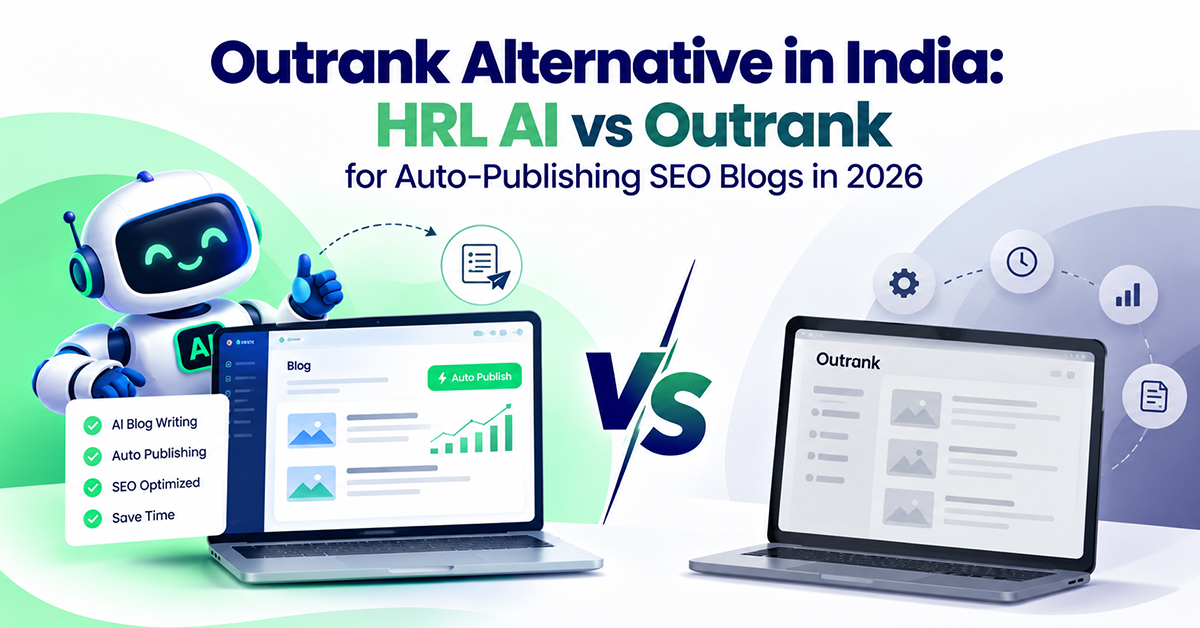
You've just finished evaluating Outrank for your website's content calendar, and the numbers on their pricing page have you pausing mid-decision. Thirty articles a month for $99 sounds reasonable until you convert it to rupees, add the card network's forex markup, and realise your monthly bill shifts every cycle depending on the exchange rate. For a growing Indian brand, SaaS startup, or agency managing several client sites, that currency uncertainty alone is reason enough to ask what else exists.
This comparison looks at HRL Infotechs AI against Outrank specifically for businesses that bill in rupees and publish primarily for an Indian or South Asian audience. You'll see what each platform actually includes at every price tier, where the real cost difference shows up once add-ons enter the picture, and which one fits a team that needs blogs published consistently, not just drafted. By the end, you should know exactly which plan matches your publishing volume, and what to check before you commit to either one.
What Is Outrank and Why Are Indian Teams Searching for Alternatives?
Outrank is a Paris-based AI SEO platform built around auto-publishing. It researches keywords, writes full articles, and pushes them straight to WordPress, Webflow, Shopify, or a handful of other platforms without a human at every step. The Organic Growth plan starts at $99 a month for 30 articles, with automated backlink building and AI images bundled in.
For a lot of Indian teams, the platform itself isn't the problem. The billing currency is. Every add-on from there, extra articles, premium backlinks, human-curated review, stacks in US dollars, and international card transactions usually carry a 2 to 3.5% forex markup on top of whatever rate the bank applies that day. A $99 subscription can land closer to ₹9,000 a month once those charges settle, before you've touched a single add-on. That is exactly why many Indian marketers start researching an Outrank Alternative that bills in INR from day one.
HRL Infotechs AI vs Outrank at a Glance
Both platforms promise the same outcome: less manual work, more published content. They reach it differently, and the gap matters most once you look past the headline price. Whether you call it an AI blog writer or a full AI SEO tool, the real test is what happens after the draft is generated.
Here's how the two compare on the points that actually decide whether auto-publishing works for your team:
Entry price: HRL Infotechs AI starts at ₹999/month for 15 blogs. Outrank starts at $99/month for 30 blogs, with 2–4 site bundles getting a 10% volume discount.
Languages: Outrank generates content in 150+ languages. HRL Infotechs AI focuses on English and Indian-market content, which keeps quality tighter for a single-market strategy.
Backlinks: Outrank bundles automated backlink building into its base plan. HRL Infotechs AI runs backlinks as a separate Guest Blogger workflow, pitching to vetted publishers with a minimum Domain Authority of 35.
Images: Outrank includes AI images on every plan. HRL Infotechs AI's ₹2,999 plan pairs 15 blogs with 15 banner images, while the lower tiers leave visuals out.
Billing: Outrank bills in USD, with forex conversion applied on every Indian card transaction. HRL Infotechs AI bills directly in INR.
Support model: Outrank runs on email support tied to its France-based team. HRL Infotechs AI's Automated Blog Writing Tool is built around onboarding and strategy calls timed to Indian business hours.
None of this makes one platform universally better. It just means the comparison needs to go deeper than the sticker price, which is where the next two sections come in.
How Does Pricing Compare in Rupees and Dollars?
Direct answer: Outrank's base plan runs $99 a month, close to ₹8,200 before forex markup, for 30 articles. HRL Infotechs AI's comparable 30-article tier, the ₹1,999 Content Growth plan, costs roughly $24 at current exchange rates, before any card conversion fees even apply.
Before you lock into either plan, it helps to separate what counts as a true AI SEO tool from a basic draft generator. Pricing only makes sense once you know whether keyword research, metadata, and publishing are actually included, or sold back to you as paid add-ons.
The gap widens as you scale. Outrank's 60-article add-on costs an extra $85 a month, and the 90-article tier adds $160, pushing the total to $259, somewhere around ₹21,500 once the base plan is counted in. HRL Infotechs AI doesn't meter output the same way past its three published tiers. Its Agency plan moves to unlimited publishing at a flat rate, which changes the math for anyone running more than one site.
That distinction matters just as much if you're shopping for an AI blog writer rather than a full platform. A cheaper monthly rate isn't much of a saving if you're still doing the research and formatting work by hand.
Here's a judgment call worth making explicitly: if you're publishing under 20 articles a month and don't need backlink building bundled in, Outrank's $99 plan is mostly idle capacity you're paying for. A full breakdown of what each INR tier actually includes, down to banner images and competitor analysis, is covered in this guide to HRL Infotechs AI's ₹999, ₹1,999 and ₹2,999 plans.
Which Features Actually Decide Whether Auto-Publishing Works?
Auto-publishing sounds simple until an article goes live with a broken product link or a claim your legal team wouldn't sign off on. The feature that matters more than word count is what happens between generation and publishing.
Outrank's Auto Optimize injects keywords from top-ranking competitor pages directly into the draft, which helps on-page SEO but doesn't check whether the claim is still accurate for your product. HRL Infotechs AI's Content Engine drafts against a brand voice profile built from your own content samples, and every generated piece still opens in an editor with version history before it reaches the publish queue.
If you're evaluating this as primarily an AI blog writer rather than a full SEO suite, check how much of the publishing workflow, metadata, and internal linking is actually automated versus left for you to finish manually.
Experience from running this kind of workflow for client sites: the articles that cause problems later are rarely the ones with weak keyword density. They're the ones published with a pricing figure or a feature claim that changed between draft and go-live. Whichever platform you choose, build in a review step for anything involving numbers, dates, or product specifics, even if it adds a day to your publishing cadence.
Does Outrank or HRL Infotechs AI Make More Sense for an Indian Team?
Outrank fits a global content operation that already budgets in dollars, publishes in multiple languages, and wants backlink building automated within the same subscription. If you're running an international SaaS blog from Bangalore but serving a US or European audience, dollar pricing isn't much of a friction point since your revenue sits in the same currency.
For a business billing in rupees, paying GST on local services, and publishing primarily for an Indian audience, HRL Infotechs AI removes the currency conversion step entirely and prices each tier around a specific publishing volume rather than a flat rate with paid add-ons stacked on top. Agencies managing multiple Indian client sites often find the unlimited Agency tier works out cheaper than Outrank's per-site volume discounts once they're past four or five properties.
How Do You Move to an AI SEO Blog Tool Without Losing Momentum?
Switching tools mid-strategy risks a gap in your publishing cadence, and search engines tend to read a sudden drop in posting frequency as declining relevance. A practical move avoids that gap rather than risking it.
Start with a parallel test instead of a hard switch. Keep your existing workflow live while the new tool handles five to ten lower-priority topics for two to three weeks, then compare the drafts against your own editorial bar rather than the platform's self-reported SEO score, since every AI SEO tool grades its own output generously.
If you're weighing HRL Infotechs AI against other auto-blogging platforms beyond Outrank, this breakdown of Koala AI versus HRL Infotechs AI walks through a similar decision process worth applying here too.
Once you trust the output, migrate your keyword list in batches rather than all at once. Moving 30 keywords in one week makes it hard to isolate what's working if rankings move, good or bad.
Keep a human checking metadata, internal links, and factual claims on every article for at least the first month, regardless of which platform you choose. That single habit prevents most of the corrections teams end up making six weeks after going all-in on automation.
If you've read this far, you already know your current content output isn't matching what your SEO strategy needs, whether that's because Outrank's dollar pricing doesn't fit an India-based budget or because any new tool feels risky without a trial run first. Talk to the HRL Infotechs AI team about which plan matches your actual publishing volume before you commit to either platform.