You know the situation. Your website needs fresh content, your competitors are publishing every week, and you already have a list of topics sitting somewhere in a spreadsheet. But finding time to research keywords, write articles, optimise them, add internal links and actually publish them is another matter.
An AI blog writing tool can take a large part of that workload off your team. But the real benefit isn't simply that AI can write an article quickly. The bigger advantage is having one repeatable workflow for research, content creation, SEO optimisation, scheduling and publishing. For an Indian business trying to maintain 30 SEO blogs a month, that difference can be significant.
Can you publish 30 SEO blogs a month without hiring a writing team?
Yes, you can, provided you build a content system rather than simply generating 30 articles with AI. The difficult part isn't producing words. It's deciding what deserves to be published, making sure each article has a purpose, and keeping the quality consistent.
Think about what happens when you create one blog manually. You research the topic, check competitors, find keywords, prepare an outline, write the article, edit it, create metadata, add links, upload it to your CMS and finally publish it.
Now multiply that process by 30.
That's where automation becomes useful.
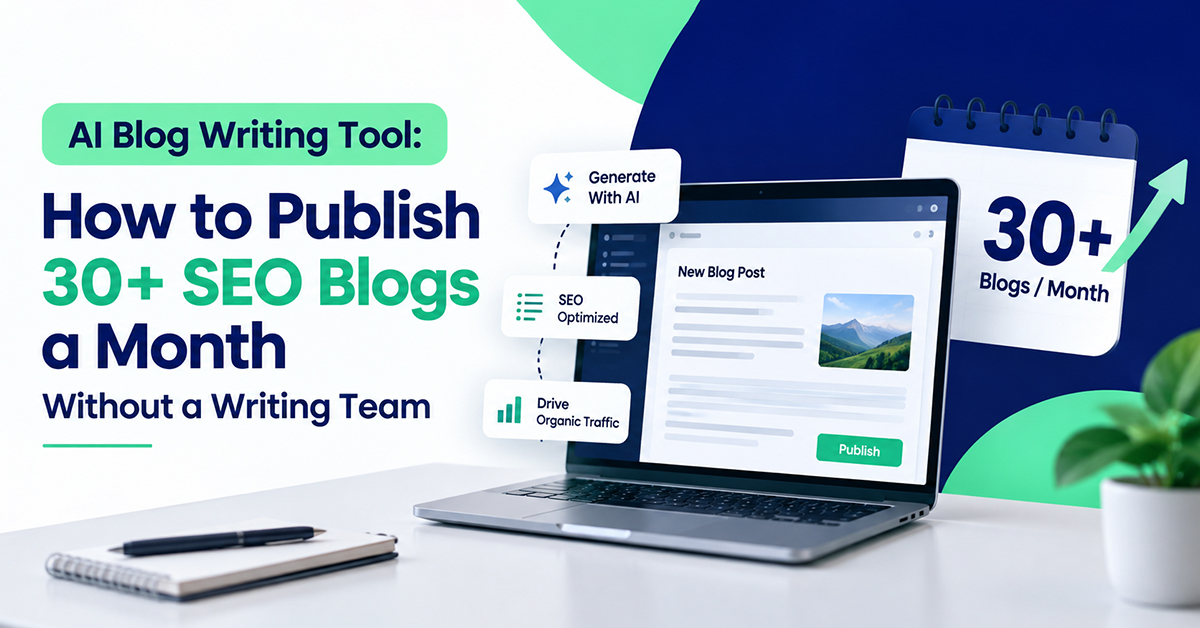
An AI blog writing platform can connect several of those steps into one workflow. HRL Infotechs AI's. AI Blog Agent for automated blog creation and publishing is designed around this type of workflow, including SEO content creation, scheduling and automated publishing.
The important point is that you still need human direction. AI can handle repetitive production work, but someone should decide what the business wants to be known for and whether the final content is actually worth publishing.
What does an AI blog writing tool actually do?
An AI blog writing tool helps automate the repetitive parts of content production, from finding topics and researching keywords to creating drafts, optimising articles and preparing them for publication.
A useful workflow usually looks like this:
Find opportunities from keywords, competitors and customer questions.
Choose topics based on search intent and business relevance.
Create the article around the selected topic.
Optimise the content with headings, metadata, keywords and internal links.
Review the article for accuracy, originality and brand fit.
Publish and schedule the finished content.
Measure performance using search and website data.
This is very different from opening an AI chatbot and typing, "Write a 1,500-word SEO blog."
The chatbot gives you text.
A proper content workflow gives you a process.
That's an important distinction if your goal is to publish consistently rather than occasionally experiment with AI writing.
Why shouldn't you start with writing?
Because the fastest way to waste time with AI is to generate content before deciding whether anyone actually needs it.
Imagine you run an Indian ecommerce business selling skincare products. You could ask an AI tool to produce 30 articles about skincare. You'd probably have them quickly.
But should those 30 articles exist?
A better approach would be to examine what potential customers are actually searching for. Some searches may be educational, such as questions about ingredients. Others may compare products. Some may indicate that the person is close to buying.
Those searches represent different stages of the customer journey.
Your content should reflect that.
This is why search intent should come before content generation. HRL Infotechs AI's own SEO guidance recommends starting with customer questions and building connected topic clusters rather than producing unrelated AI-generated articles.
A simple rule I use is this:
Don't ask AI what to write until you know why the page should exist.
That one decision can prevent a lot of low-value content.
How does automated blog publishing make a difference?
Writing an article is only one part of content marketing. Someone still has to move that article into the website, format it, add metadata, schedule it and make sure it actually goes live.
That administrative work adds up.
For example, if publishing one finished article takes 10 minutes, manually publishing 30 articles takes around five hours. That's five hours spent on repetitive CMS work rather than strategy, editing or customer research.
Automated blog publishing reduces those handoffs.
Once your website and publishing workflow are configured, articles can move through the process with much less manual intervention. HRL Infotechs AI positions its platform around automated publishing and recurring content workflows rather than content generation alone.
There is a catch, though.
Don't remove the approval step for every type of content.
For routine informational articles, automation can work well. For content involving medical advice, financial claims, legal information, product specifications or sensitive business statements, human review remains essential.
Speed is useful. Unchecked speed isn't.
Can an AI blog writer create content that is actually useful?
Yes, but the tool itself doesn't determine whether the final article is useful. The quality of the research, instructions, source material and review process matters just as much.
This is one of the biggest differences between using AI casually and using it as part of an SEO workflow.
A generic AI writer may produce an article that sounds perfectly reasonable. The problem becomes obvious when you compare it with ten competing pages and realise that all eleven articles are saying essentially the same thing.
Changing the wording doesn't make the information original.
Your article needs something extra.
That could be a practical example from your business, an original process, first-hand observations, customer questions, product comparisons, industry-specific data or an explanation of a problem competitors have overlooked.
HRL Infotechs AI's recent guidance makes the same distinction between using AI to accelerate production and maintaining human control over accuracy, expertise and content quality.
That's also why publishing 30 weak articles isn't necessarily better than publishing 10 strong ones.
What should AI handle and what should humans handle?
The best results usually come from dividing the work intelligently.
AI can handle | Human should handle |
|---|---|
Keyword research assistance | Business priorities |
Topic suggestions | Final topic selection |
First drafts | Experience and expertise |
SEO structure | Accuracy checks |
Meta descriptions | Important claims |
Internal-link suggestions | Brand positioning |
Publishing and scheduling | Final approval |
Performance summaries | Strategic decisions |
The most useful lesson here is simple: automate repetition, not responsibility.
For example, AI can suggest five internal links. Your SEO manager can decide that only three actually make sense for the reader.
AI can identify a keyword opportunity. Your team can decide that the keyword doesn't fit the product or customer.
That small layer of judgement is what stops an automated content system from becoming a content factory that produces pages nobody needs.
Can 30 blogs help build topical authority?
They can, but only when the 30 articles are connected by a clear subject and search journey.
Topical authority isn't created by hitting a monthly article target. It comes from covering a subject comprehensively enough that your website becomes a useful destination for related questions.
For example, a website targeting AI SEO could build a content cluster around:
AI SEO → AI content → AEO → GEO → AI search → SEO automation → content strategy
Each article answers a different question. Internal links then connect the pages so readers can move naturally from one topic to another.
This is much stronger than publishing 30 unrelated articles simply because you have the capacity to produce them.
HRL Infotechs AI's current content strategy recommends connected topic clusters and internal linking as part of a broader SEO and AI-search approach.
If you're building a similar strategy, the site's guide on AI SEO content strategy for Google, ChatGPT and Gemini is a useful supporting resource.
Does AI-generated content need human editing?
Absolutely. Human editing isn't just about correcting grammar.
A good editor asks harder questions:
Does this claim have evidence?
Is this actually what the customer wants to know?
Does the article say anything competitors haven't already said?
Is the example realistic?
Does the tone match the business?
Does the article make a promise the company can't support?
Those questions matter because AI can produce confident-sounding sentences even when the underlying information needs checking.
The same issue appears in AI search optimisation. HRL Infotechs AI's recent guidance on answer-first content recommends giving users direct answers while supporting them with context, evidence and useful explanations.
That's a much better objective than simply making an article "sound human."
How much does it cost to publish 30 SEO blogs?
The answer depends on what you're comparing.
If you use separate writers, editors, SEO tools and publishing support, you're paying for several pieces of the same workflow. An integrated AI platform attempts to bring more of those activities into one system.
HRL Infotechs AI currently promotes its AI Blog Agent as a solution for businesses that want to automate SEO content creation and publishing. Its website should be checked for the latest plan pricing and inclusions before purchase.
But don't make the mistake of comparing only subscription prices.
Compare the total workflow cost.
If a cheap AI tool requires hours of manual keyword research, editing, formatting and uploading every month, its low subscription price may not mean much.
A slightly more integrated system can be more useful if it removes several repetitive steps.
What should you check before choosing an AI blog content tool?
Before buying anything, test the workflow with a real topic from your own business.
You should be able to answer yes to most of these questions:
Can it identify relevant topics instead of just generating random ideas?
Can it understand search intent?
Can it analyse competing content?
Can it create a logical article structure?
Can it produce SEO metadata?
Can it suggest relevant internal links?
Can it connect with your CMS?
Can it schedule content?
Can you review the article before publication?
Can you measure what happens after publication?
This test is more revealing than an impressive product demo.
Ask the platform to create an article about a topic your business actually targets. Then check the research, examples, keyword usage, internal links and factual claims.
You'll quickly see whether you're looking at a genuine content workflow or simply a text generator.
How should you plan 30 SEO blogs every month?
Don't start the month by choosing 30 random keywords.
Start with your business priorities.
Suppose you have five major services. You could build several supporting topics around each service, covering informational questions, comparisons, problems, use cases and commercial searches.
Then spread those topics across the month.
Week 1: Research keywords and select topic clusters.
Week 2: Create the first batch of articles and review quality.
Week 3: Publish supporting content and strengthen internal links.
Week 4: Check Search Console data and adjust the next month's topics.
The last step is easy to ignore, but it's where the learning happens.
If an article receives impressions but very few clicks, examine the title and search intent. If another article gets strong engagement, look for related questions you haven't covered yet.
Content production should become a feedback loop, not a monthly quota.
HRL Infotechs AI has also documented what early Search Console performance can look like after publishing 30 blogs in 30 days. The important lesson is that new content shouldn't be judged by expecting immediate traffic spikes.
You can see the [30 blogs in 30 days Search Console analysis] for that practical perspective.
Can an AI blog writing tool replace a content team?
It can reduce the amount of manual production work your team needs, but replacing an entire content team is a different question.
AI is particularly useful for repetitive tasks such as research assistance, outlining, drafting, metadata, internal-link suggestions and publishing.
It doesn't automatically know your customers.
It doesn't sit in your sales meetings.
It doesn't know which objections prospects raise repeatedly.
And it doesn't have genuine first-hand experience unless that information is provided to it.
That's why the strongest model is usually AI-assisted content production, not completely unattended publishing.
Your strategist provides the direction. Your subject expert provides the knowledge. AI handles much of the repetitive execution.
That balance gives you something a manual process often struggles with: consistency without giving up judgement.
What should you do before publishing 30 blogs a month?
Start small.
Choose your website, define your target customer, identify three to five important content themes and select a few topics for an initial test.
Connect your CMS and create the publishing workflow. Review the first articles carefully. Check whether the topics match your business, whether the information is accurate and whether the internal links make sense.
Then scale.
The process you want is:
Research → Topic Selection → Writing → SEO Optimisation → Review → Publishing → Measurement → Improvement
Once that cycle works consistently, increasing your publishing volume becomes much easier.
And that's really the value of an AI blog writing tool. It isn't about filling your website with 30 pieces of text every month. It's about turning content production from a task that constantly gets postponed into a repeatable marketing process.
Ready to make your content workflow more consistent?
If your website needs regular SEO content but your team doesn't have the time to research, write, optimise and publish every article manually, automation may be worth testing.
The HRL Infotechs AI platform is built around AI-assisted content creation, SEO workflows and content automation.
Before choosing a plan, test the workflow with your own website and topics. If it saves your team meaningful time while maintaining the level of quality your audience expects, then scaling from a few articles to 30 a month becomes a practical next step.