A D2C brand can now use an AI content generator to produce 20 articles in the time it once took to publish five. That sounds like an obvious SEO advantage until you check Search Console a few months later and discover that most of those pages have barely moved. The problem usually isn't that AI was used. The problem is that the content was produced faster than the strategy behind it.
So, what actually ranks on Google in 2026: AI content or human-written content? Neither gets an automatic advantage. Google evaluates the quality and usefulness of the finished content, not simply whether a human or AI wrote the first draft. AI can accelerate research, writing and optimization, but experience, originality, accuracy and strategic judgement still determine whether the final page deserves attention.
Does AI-Generated Content Rank on Google in 2026?
Yes, AI-generated and AI-assisted content can rank on Google in 2026. Google does not automatically demote a page because AI was used to create it. The real issue is whether the finished content satisfies the searcher's intent and provides meaningful value.
That distinction is becoming increasingly important. Generative AI makes it possible for a small marketing team to publish dozens of pages every month. But producing 30 pages instead of 10 doesn't help if those pages repeat information already available elsewhere.
Google's guidance focuses on useful, reliable and people-first content. It also warns against using automation to generate large amounts of low-value content primarily for manipulating search rankings. (Google Search Central)
In practical SEO work, the better question isn't "Was AI used?"
It is:
"Why would Google or a reader choose this page instead of the next result?"
If the answer is only "because we used the keyword more often," there is a problem.
AI Content Generator vs Human Writers: Which Performs Better?
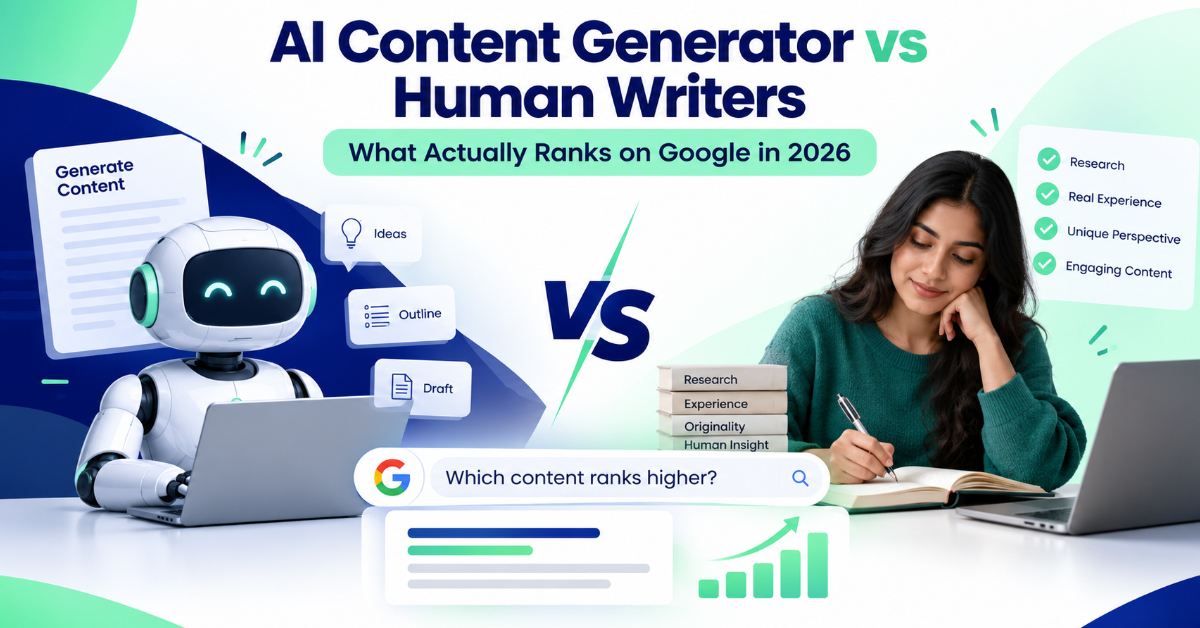
An AI content generator usually wins on production speed. Human writers usually have the advantage when a topic requires first-hand experience, original analysis, specialist knowledge or strategic judgement. For most businesses, the strongest approach is to combine the two rather than choosing one.
Imagine an Indian SaaS company targeting "SEO automation software." An AI system can analyze competing topics, identify related questions and create an initial draft in minutes. It cannot automatically know which customer objections the sales team hears every week or which product limitations need to be explained honestly.
That information comes from the business.
The human strategist provides the direction. AI helps execute the repetitive parts of the process.
This is the approach behind HRL Infotechs' AI, where AI content creation is positioned as part of a broader SEO workflow rather than as a standalone text-generation feature.
There is a real trade-off here. Remove human involvement completely and you gain speed but risk producing generic content. Make everything manual and you may protect quality but struggle to scale.
The better model is simple: automate production, not judgement.
What Actually Makes AI-Assisted Content Rank?
AI-assisted content has a stronger chance of ranking when it satisfies search intent, contributes original information, demonstrates relevant expertise and remains accurate. The writing technology is only one part of the equation.
Search intent comes before content generation
Search intent is the reason someone performs a search. A person searching "AI content generator free" may want to test a tool. Someone searching "best AI writing tool 2026" is likely comparing options. Someone searching "does AI content rank on Google" wants an explanation.
Those searches may contain similar vocabulary, but they represent different needs.
Before generating an article, identify what the user is actually trying to accomplish. Otherwise, even a perfectly optimized article can target the wrong intent.
Original information matters more than word count
A 2,500-word article isn't automatically better than a 1,200-word article.
If ten competitors already explain the same definition, rewriting that information with different sentences doesn't create much additional value.
Originality can come from a real workflow, first-hand observations, original research, tested processes, expert opinions, customer questions or specific examples from the industry.
This is especially important for AI-generated content because the technology makes it very easy to reproduce the same general information found across hundreds of websites.
Experience gives content an advantage
Consider two articles about technical SEO.
One explains crawling, indexing, canonical tags and XML sitemaps using standard definitions.
The other explains how an ecommerce website accidentally created thousands of indexable URL variations, how the problem was discovered, and why changing the canonical tags alone didn't resolve the issue.
The second article demonstrates experience.
AI can help explain the problem clearly, but it shouldn't invent that experience.
Expertise affects strategic decisions
Expertise isn't about filling an article with complicated terminology.
It is about making the right decisions.
An AI keyword research tool might identify 100 related keywords. An experienced SEO strategist may decide that only 15 represent distinct search opportunities because the rest have almost identical intent.
That decision prevents unnecessary pages and potential keyword cannibalization.
AI can identify possibilities.
Human expertise determines which possibilities are worth pursuing.
Accuracy builds trust
AI can produce a confident answer that isn't correct.
That means important claims still need verification. Statistics, product specifications, dates, technical recommendations, regulations and performance claims should be checked before publication.
A polished sentence is not evidence.
If a number is illustrative, identify it as illustrative. If a claim cannot be verified, don't present it as established fact.
Should You Use an AI Content Generator for SEO?
Yes, but the tool should accelerate your SEO process rather than replace your strategy.
An AI content generator is particularly useful for research assistance, outlines, first drafts, content expansion, metadata and repetitive optimization. It becomes risky when the workflow is reduced to keyword selection, automatic generation and immediate publishing.
I've seen this happen in content programs that scale quickly. The first few AI articles look excellent. After 20 or 30 pages, the similarities become obvious. Introductions start sounding the same, examples repeat, and several URLs begin targeting almost identical search intent.
The problem isn't the AI model.
The problem is the absence of an editorial system.
Before generating an article, define the audience, search intent, primary keyword, supporting topics, competitor gaps, unique information and business objective.
That gives the AI something useful to work from.
For a deeper explanation, see HRL Infotechs AI's guide on how to use an AI content generator without losing Google rankings and E-E-A-T signals.
What Is the Role of an AI SEO Tool?
An AI SEO tool should do more than generate paragraphs. Its real value comes from connecting keyword research, content optimization, competitor analysis, technical SEO and performance tracking.
For example, imagine an existing page is ranking around position 11 for a valuable commercial keyword. Creating another article around a similar keyword may not be the best move.
Improving the existing page could be more effective.
You need to understand its ranking keywords, search intent, competitor coverage, content gaps and internal-link structure before deciding what to do next.
That is where an AI SEO tool becomes more useful than a simple writing assistant.
The tool can process large amounts of search data quickly. The SEO strategist still decides what the business should prioritize.
How Does an AI Keyword Research Tool Improve SEO?
An AI keyword research tool can speed up the discovery of long-tail queries, related topics, questions, search-intent patterns and competitor gaps.
But keyword volume alone shouldn't determine your content strategy.
Suppose a SaaS company finds 50 keywords around "AI SEO tool." Several may have good search volume, but many could represent the same underlying intent. Creating separate pages for all of them could dilute the website's topical structure instead of strengthening it.
A better approach is to group related searches and identify where genuinely different content is required.
This is one area where AI and human SEO expertise complement each other particularly well. AI handles large-scale discovery. The strategist decides which opportunities have genuine business value.
What Makes Good SEO Automation Software?
Good SEO automation software removes repetitive work while keeping important strategic decisions under human control.
That's an important distinction.
Automation can handle recurring keyword discovery, content workflows, reporting, optimization checks and publishing tasks. But automation shouldn't mean that every decision is made without review.
For example, an agency managing 20 clients shouldn't have a senior strategist manually compiling the same ranking report every week. That work can be automated.
The strategist should instead spend that time understanding why rankings changed, which pages need improvement and where the next commercial opportunity exists.
The real benefit of SEO automation software isn't eliminating SEO professionals.
It is allowing experienced SEO professionals to spend more time on high-value decisions.
Can an SEO Content Generator Create Content That Ranks?
An SEO content generator can create a useful starting draft, but it cannot guarantee rankings.
A strong SEO content generator should work from search intent and topic relevance rather than simply inserting an exact-match keyword into headings and paragraphs.
There is another issue that businesses often overlook: existing content.
If your website already has an article ranking on page two for an important query, generating another article around a nearly identical keyword may not be the smartest move.
Improving the existing page with better evidence, stronger examples, missing subtopics and relevant internal links could produce a better result.
Generation is only one step in SEO.
Strategy determines what should actually be generated.
What Does an AI SEO Writer Actually Do?
An AI SEO writer can accelerate research, outlining, drafting and optimization. It can help a writer start with a structured page rather than a blank document.
But it shouldn't decide what your brand believes.
That responsibility belongs to your team.
For example, an AI SEO writer can create an explanation of technical SEO. It can structure sections around crawlability, indexing and internal links. It can also suggest questions that users may ask.
It cannot independently know whether your website has a specific indexing problem unless it has access to the relevant data and the workflow is designed to analyze it.
The same principle applies to brand expertise.
AI can reproduce a tone.
It cannot replace the experience behind that tone.
Can AI Content Appear in Google AI Overviews?
Yes, AI-assisted content can potentially appear within Google's AI-powered search experiences, but there is no separate shortcut that guarantees inclusion.
Google continues to emphasize foundational SEO practices for its generative search features, including crawlability, indexing, helpful content and clear information.
This makes AEO and GEO less about writing artificial "AI-friendly" sentences and more about making useful information easy to understand.
Answer important questions directly. Define key terms. Use descriptive headings. Support claims with reliable sources. Connect related pages through useful internal links.
For a broader view of this shift, see HRL Infotechs AI's guide to AI search optimization beyond traditional Google rankings.
The important point is that AEO and GEO should strengthen your SEO strategy, not replace it.
What AI Content Mistakes Can Hurt SEO?
The biggest mistake isn't using AI. It is publishing content without asking whether the page deserves to exist.
AI makes it easy to create a separate article for every keyword variation. But several keyword variations may represent exactly the same search intent. In that situation, one strong resource can be more useful than five thin pages.
Competitor rewriting is another problem. Studying the SERP helps you understand what information searchers expect. Rewriting the top-ranking pages with different wording doesn't automatically create something better.
The same applies to "humanizing" AI content.
Changing sentence structure, adding contractions or replacing formal words doesn't create genuine experience.
If the article lacks evidence, add evidence.
If it lacks first-hand knowledge, involve someone who has actually done the work.
If it lacks original information, research something competitors haven't covered.
That is what makes content better.
How Should You Combine AI and Human Writers?
The most effective model is to let AI handle speed while humans handle judgement.
AI can research keywords, analyze competitors, group topics, build outlines and produce a first draft. The SEO strategist then checks whether the opportunity is commercially relevant and whether the content is targeting the correct search intent.
A subject expert adds the information that generic AI output normally lacks: customer objections, real implementation details, product limitations, tested processes and opinions based on experience.
The editor then turns those inputs into a coherent final article.
This approach is faster than doing everything manually while still protecting the quality signals that matter.
The goal isn't to hide AI involvement.
The goal is to make the finished content genuinely useful.
What Should You Do Before Publishing AI Content?
Before publishing, use a simple six-step quality process:
Identify the search intent and define what the reader should accomplish after reading the page.
Research the SERP and content gaps rather than copying a competitor's structure.
Use AI for research and drafting while keeping the strategy human-led.
Add genuine expertise and original information that competitors don't already provide.
Check SEO and technical elements, including internal links, metadata, indexability and page structure.
Measure performance after publication and improve the page based on actual search data.
The last step is often forgotten.
Publishing isn't the finish line.
A page receiving impressions but few clicks may need a stronger title. A page ranking on page two may need deeper coverage. A page attracting traffic but generating no leads may have an intent or conversion problem.
SEO is an ongoing feedback loop.
What Should You Do With Existing AI-Generated Content?
Don't delete an article simply because AI was involved.
First evaluate its quality and performance.
Look for pages with declining impressions, weak rankings, overlapping search intent, outdated information, unsupported claims or weak internal linking.
Then decide whether the page should be updated, expanded, consolidated, redirected or removed.
In many cases, the strongest SEO improvement isn't another article.
It is improving the content you already have.
If three pages cover almost the same search intent, consolidating them into one stronger resource can create a better user experience and a clearer topical structure.
How Can Businesses Scale AI Content Without Sacrificing Quality?
Start with the quality process before increasing the publishing volume.
Use AI for research, drafting, keyword analysis and repetitive optimization. Keep humans responsible for search intent, factual verification, original insights and final approval.
This is where HRL Infotechs AI brings several parts of the workflow together, including content creation, keyword tracking, SEO intelligence and automation.
The objective isn't to create as many articles as possible.
It is to create a repeatable system where your team can produce useful content consistently without spending all its time on repetitive production work.
The Real Answer: AI + Human Expertise Wins
The AI versus human debate is too narrow.
AI gives you speed. Human expertise gives you context. SEO strategy determines what deserves to be created. Technical SEO makes sure search engines can access it. Performance data tells you what should happen next.
That combination is much more sustainable than relying entirely on either side.
If your current process is still "find a keyword, generate an article and publish it," the next improvement probably isn't another AI writing prompt.
You need a connected workflow covering keyword research, content creation, optimization, internal linking, technical SEO and performance measurement.
That is where AI becomes an SEO advantage rather than simply a faster way to produce text.
Frequently Asked Questions
Q1. Is AI-generated content bad for SEO in 2026?
Ans: No. AI-generated content is not automatically bad for SEO. Google evaluates the quality, usefulness and relevance of the finished content rather than simply whether AI was used. The risk comes from producing large volumes of low-value content primarily to manipulate rankings. AI works best when combined with human review, original information and genuine expertise.
Q2. Can AI content rank #1 on Google?
Ans: Yes, AI-assisted content can rank highly on Google when it satisfies search intent and provides useful, accurate and original information. However, using an AI content generator doesn't provide a ranking advantage by itself. The finished page still needs strong SEO fundamentals, relevant expertise, useful content and a reason to outperform competing results.
Q3. Is human-written content better than AI content?
Ans: Not automatically. Human-written content can still be generic, inaccurate or poorly optimized. Human involvement becomes particularly valuable when the topic requires first-hand experience, specialist expertise, original research, strategic judgement or factual verification. The strongest approach for many businesses is AI-assisted production combined with human editorial and SEO oversight.
Q4. What is the best AI content generator for SEO?
Ans: The best AI content generator depends on your SEO requirements. Don't evaluate a tool only by how quickly it writes articles. Look for keyword research, search-intent analysis, content optimization, internal linking, technical SEO support, publishing workflows and performance tracking. A connected SEO workflow can provide more value than a tool focused only on text generation.
Q5. Can an AI SEO writer replace human writers?
Ans: An AI SEO writer can replace parts of the production process, especially research assistance, outlining, drafting and repetitive optimization. It should not completely replace human expertise. Writers and SEO specialists are still needed for original insights, brand positioning, fact-checking, subject expertise and decisions involving important business or customer claims.
Q6. How can I make AI content rank better on Google?
Ans: Start with the correct search intent and provide information that competing pages don't already offer. Add genuine experience, original examples, verified evidence and expert insight. Use relevant internal links, clear headings, technical SEO and natural keyword placement. After publication, monitor rankings, impressions, clicks and conversions and update the content based on real performance.