You’ve probably seen AI writing tools advertised for a few hundred rupees a month, but the monthly price alone doesn’t tell you much. If you're comparing the AI blog writing tool price in India, the real question is what happens after the article is generated. Do you still need to research keywords, create an SEO structure, add metadata, prepare images and publish every article yourself?
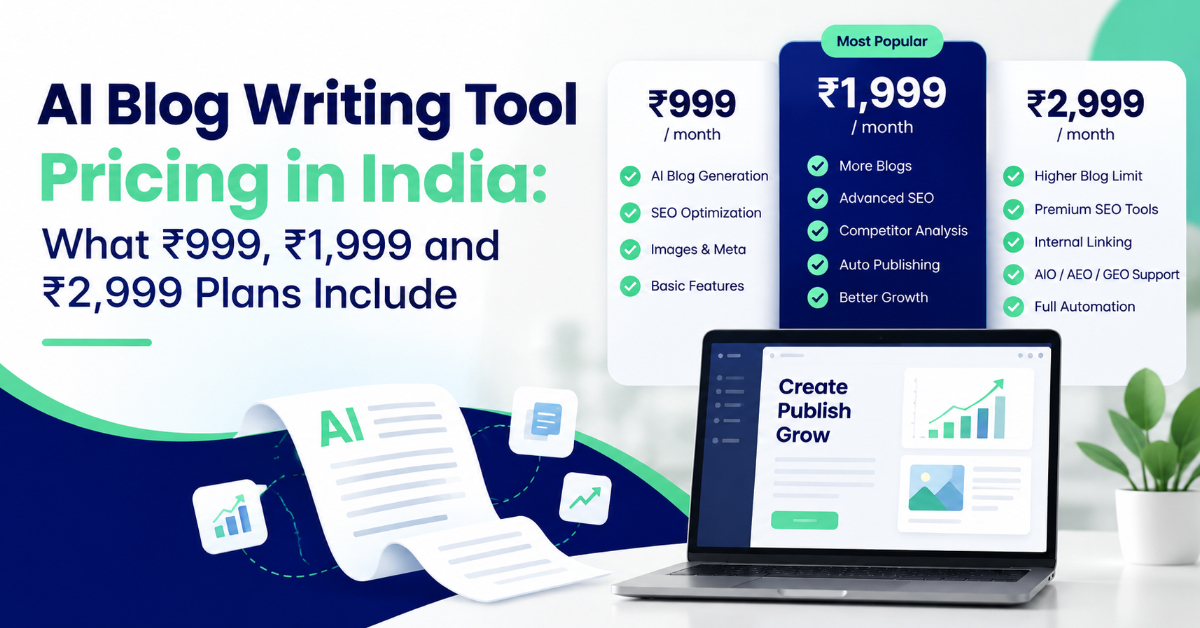
For businesses comparing the ₹999, ₹1,999 and ₹2,999 options, the difference is mainly about content volume, depth of automation and visual content. The ₹999 plan focuses on consistent publishing, ₹1,999 increases the publishing capacity and adds deeper competitor analysis, while ₹2,999 combines blogs with banner images.
What Should You Look for in an AI Blog Writing Tool?
An AI Blog Writing Tool should do more than turn a prompt into a 1,000-word article. A useful content workflow should help with topic selection, keyword research, content structure, SEO elements, internal linking and publishing.
This matters because the cheapest tool isn't always the cheapest workflow. If you spend ₹999 on software and then several hours every week researching topics, editing articles, adding links and uploading posts, you're still carrying most of the workload yourself.
A practical AI Content Generator should reduce those repetitive steps without removing human review. The goal isn't to publish as much content as possible. The goal is to make consistent publishing easier while keeping the content useful.
How Much Does an AI Blog Writing Tool Cost in India?
For the plans discussed here, the monthly pricing starts at ₹999, followed by ₹1,999 and ₹2,999. The three options are built around different publishing requirements rather than simply giving you different versions of the same writing software.
Here's the simplest way to understand them:
₹999: 15 SEO blogs per month with essential publishing and SEO features.
₹1,999: 30 SEO blogs per month, longer content and advanced competitor analysis.
₹2,999: 15 SEO blogs plus 15 banner images per month.
The important part is matching the plan to your actual workflow. Buying capacity you won't use doesn't improve your SEO strategy.
What Does the ₹999 Content Starter Plan Include?
The ₹999 plan is built for businesses that want to start publishing consistently without committing to a large content operation. It includes 15 SEO blogs per month, one connected website, auto-publishing, a content calendar and SEO meta and heading structure.
It also supports WordPress, Shopify and custom website integrations. Banner images aren't included, so you'll need to handle featured visuals separately.
This can work well for a local service business, small ecommerce website or new brand that has plenty of useful topics but hasn't built a regular publishing routine yet.
A common mistake at this stage is trying to publish every possible keyword at once. Fifteen well-connected articles around one subject can give your website a clearer topical direction than 15 unrelated posts.
If you're interested in understanding how higher-volume publishing works, this guide on publishing 30+ SEO blogs each month with an AI blog writing tool is a useful next step.
Is the ₹1,999 Plan Better for Growing Websites?
The ₹1,999 Content Growth plan increases the monthly output to 30 SEO blogs. It also adds advanced competitor analysis and supports long-form content of up to 1,200 words.
That's a meaningful change for businesses that already have a content strategy and want to cover a wider range of searches each month. You can work with topic clusters instead of treating every blog as a separate project.
For example, an ecommerce brand selling skincare products might create separate content around product comparisons, ingredient guides, buying questions, skin concerns and category-level searches. Those pages can then connect through relevant internal links.
This is where an AI SEO tool becomes more useful than a basic writing assistant. The writing itself is only one part of the process. What matters is how the content fits into the website's wider search strategy.
HRL Infotechs AI also discusses this approach in its guide to building an AI SEO content strategy for Google, ChatGPT and Gemini.
What Do You Get With the ₹2,999 Plan?
The ₹2,999 Content Growth with Images plan takes a slightly different approach. Instead of doubling the number of articles, it combines 15 SEO blogs with 15 banner images each month.
You also get one connected website, auto-publishing, a content calendar, SEO metadata and heading structure, along with WordPress, Shopify and custom integrations.
This option is particularly relevant if your content team spends time creating a featured image for every blog. Instead of treating writing and visual production as two separate tasks, they can become part of the same publishing workflow.
There is a trade-off, though. You get 15 blogs rather than the 30 included in the ₹1,999 plan. So don't choose the image plan simply because it has more features. Choose it if images are genuinely part of your monthly bottleneck.
What Is the Difference Between an AI Blog Writer and an Automated Blogging Tool?
An AI blog writer primarily helps you create written content. An Automated Blog Writing Tool goes further by connecting content creation with tasks such as scheduling, optimisation and publishing.
That difference becomes obvious after you've managed content for a few months. Writing 20 articles isn't necessarily the difficult part. Finding suitable topics, checking competitors, adding internal links, preparing metadata and getting everything published on time can take just as much effort.
Automation is useful when it removes those repetitive steps.
But there is a catch. Automation doesn't replace editorial judgement. Someone should still check whether the information is accurate, whether the examples fit the audience and whether the article actually answers the searcher's question.
HRL Infotechs AI covers this issue in its article about using AI content without losing quality and E-E-A-T signals.
Which Plan Makes Sense for Your Business?
Instead of asking which plan has the most features, start with three practical questions.
How many blogs can you realistically use?
If your strategy needs around 10 to 15 articles a month, the ₹999 plan provides enough publishing capacity. If you're building larger topic clusters, 30 articles can give you more room to expand.
Do you need banner images every month?
If your publishing process already includes a designer, the image-inclusive plan may not be necessary. If creating blog visuals regularly slows your team down, having 15 banner images included can remove another production step.
How much work do you want to automate?
Look beyond the word count. Check whether the workflow covers keyword research, content structure, SEO elements, internal linking, scheduling and publishing.
This is one of the biggest differences between simply buying a cheap AI blog writer and building an actual content system.
Can AI Blogging Support AEO and GEO?
Yes, but there is no shortcut that guarantees visibility in AI-generated answers.
AEO, or Answer Engine Optimization, focuses on making content easy for answer-based search systems to understand and extract. GEO, or Generative Engine Optimization, focuses on improving how clearly a brand and its information can be understood and potentially referenced by generative search systems.
The practical approach is straightforward: answer questions clearly, use meaningful headings, support important claims, connect related pages and make the content genuinely useful.
For businesses exploring this area, the article on AI search optimization beyond traditional Google rankings explains how search visibility is expanding beyond conventional rankings.
The mistake is treating AEO or GEO as another keyword to insert into every article. It isn't. These are broader approaches to structuring and presenting information.
How Should You Evaluate an AI Content Tool Before Paying?
Before committing to any monthly plan, test the workflow with a real topic from your own website.
Check whether the tool understands your industry. Look at the quality of the keyword suggestions. Read the introduction and the first few sections carefully. Then check the metadata, headings, internal links and final formatting.
Don't judge the tool only by how quickly it generates 1,000 words.
A useful AI Content Writing Tool should make your team's work easier without creating another editing job. If every generated article needs to be rewritten from scratch, the apparent time saving disappears quickly.
A simple five-step check
Pick one real topic from your website.
Check whether the suggested search intent makes sense.
Review the article for accuracy and originality.
Check internal links and SEO structure.
See how much manual work remains before publication.
That small test can tell you far more than a polished product demo.
How Does Pricing Translate Into Your Monthly Content Workflow?
At ₹999, you're getting a starter publishing system focused on 15 blogs.
At ₹1,999, you're moving toward a higher-volume content operation with 30 blogs, longer-form content and competitor analysis.
At ₹2,999, you're choosing a mixed content workflow with 15 blogs and 15 banner images.
The right comparison isn't simply ₹999 versus ₹1,999 versus ₹2,999. Think about what each plan replaces in your current workflow. If it removes keyword research, writing, SEO formatting and publishing work, the value is different from a tool that only generates drafts.
This is also why content quality should be checked before scaling output. Publishing 30 weak articles doesn't create a strong SEO strategy. A connected group of useful articles, supported by relevant internal links and reviewed for accuracy, gives the content a much clearer purpose.
What Should You Do Before Choosing a Plan?
Start by reviewing the last three months of your website content.
Look at how many blogs you actually published, which topics were covered and how much manual work went into each article. Then decide whether your next target is consistency, higher volume or a combined blog-and-image workflow.
If your main problem is simply getting content published regularly, start with the smaller requirement. If you're already comfortable publishing and want to expand topic coverage, consider the higher-volume workflow. If visual production is slowing your blog process, compare the image-inclusive option.
The best content system is the one your team can actually maintain month after month.
If your website needs regular SEO content but research, writing and publishing are taking too much time, you can explore the AI Blog Agent and its current content plans.